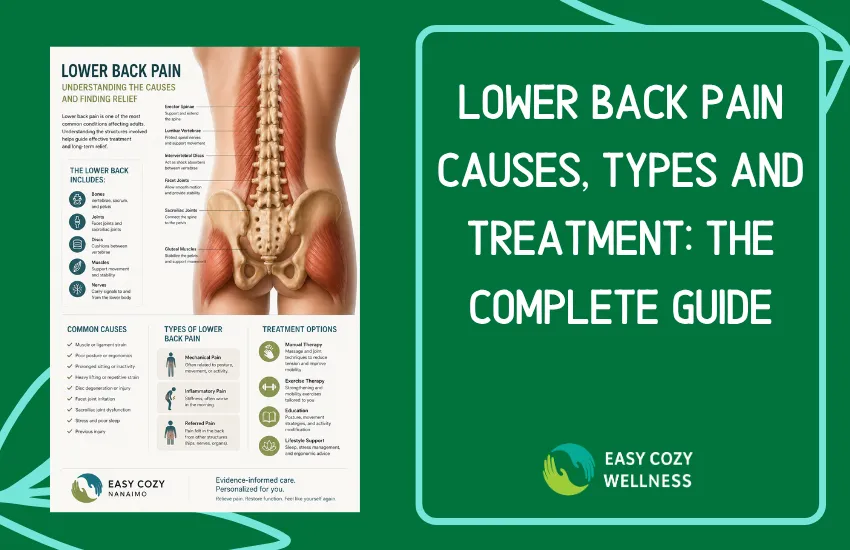
Lower Back Pain Causes, Types and Treatment: The Complete Guide
Lower Back Pain Causes, Types and Treatment: The Complete Guide
Lower back pain causes, types, and treatment options are the subject of more confusion than almost any other musculoskeletal condition, partly because back pain is so common and partly because the term covers a wide range of distinct presentations that require different approaches. This guide organises everything clearly: the main categories of lower back pain, how to identify which type you have, and which treatment is most appropriate for each.
Use this as a reference resource. Every type described here is treated regularly at Easy Cozy in Nanaimo.
Table of contents
1. How common is lower back pain
2. The 6 main types of lower back pain
3. How to identify your lower back pain type
4. Treatment options by type: what the evidence supports
5. What not to do for lower back pain
6. Prevention: keeping lower back pain from returning
7. Lower back pain treatment at Easy Cozy Nanaimo
8. Frequently asked questions
How common is lower back pain
According to Statistics Canada, lower back pain is the leading cause of disability among working-age Canadians, affecting approximately 80% of adults at some point in their lives and accounting for more lost work days than any other musculoskeletal condition. In Nanaimo, as elsewhere in BC, the combination of office-based work, trades occupations, and physically active recreational lifestyles creates a broad range of lower back pain presentations (Statistics Canada, 2024: https://www.statcan.gc.ca/en/start).
Most lower back pain is not caused by a serious underlying condition. Approximately 85% of lower back pain is classified as non-specific, meaning it is driven by muscle, fascia, and joint loading patterns rather than by identifiable structural pathology. This is good news for treatment: non-specific lower back pain responds well to targeted manual therapy combined with self-management.
The 6 main types of lower back pain
Type 1: Myofascial lower back pain (most common)
Myofascial lower back pain is driven by trigger points in the lumbar erectors, QL, hip flexors, and piriformis. It produces a dull, aching, or burning quality of pain that is worse after prolonged sitting or sustained postures, often accompanied by a morning stiffness that improves after 10-20 minutes of movement. It is bilateral or slightly asymmetric, typically not radiating below the knee, and improves with activity and worsens with static loading.
This is the most common type of lower back pain in desk workers, parents, tradespeople, and people carrying habitual postural loading. It responds very well to targeted massage and acupressure addressing the specific trigger points involved. The acupressure component is particularly effective for the deep iliacus and piriformis trigger points that standard massage cannot fully reach. [related reading: Deep Tissue Massage for Lower Back Pain in Nanaimo: How It Works & What to Expect]
Type 2: Disc-related lower back pain
The lumbar intervertebral discs can produce pain through two distinct mechanisms. Disc degeneration produces a diffuse, deep lower back ache from reduced disc height and altered load distribution across the lumbar segments. Disc herniation produces a more acute, often radicular pain that may involve buttock or leg symptoms depending on which nerve root is affected.
Disc-related pain is often worse with sustained sitting (which increases disc pressure), better with walking, and may include a directional preference (certain movements that reduce the pain more than others). Massage and acupressure can significantly reduce the surrounding muscle tension and guarding that amplifies disc-related pain, even when the disc itself cannot be directly treated. Physiotherapy with specific directional exercise is appropriate when a strong directional preference is present.
Type 3: Facet joint lower back pain
The lumbar facet joints connect each pair of vertebrae and are subject to cumulative loading and degeneration. Facet joint pain produces a characteristic pattern: aching in the lower back that is worse on standing and walking, better on sitting, and often accompanied by a stiffness in extension (bending backward). It is common in older adults and in people with significant lordotic posture.
Manual therapy addressing the surrounding muscle tension reduces facet joint loading and provides meaningful pain relief. Direct joint mobilisation through chiropractic or physiotherapy manipulation may also be appropriate when joint hypomobility is confirmed on assessment.
Type 4: Sacroiliac joint pain
The sacroiliac (SI) joint connects the sacrum to the pelvis on each side. SI joint pain produces a deep, often one-sided aching in the lower back and upper buttock region. It is frequently reproduced by standing on one leg, walking up stairs, or getting up from a seated position. It can refer into the groin or down the back of the thigh.
SI joint dysfunction responds to manual therapy addressing the surrounding hip and gluteal muscles, combined with specific joint mobilisation where indicated. The piriformis is often a significant contributor to SI joint loading and responds well to direct acupressure treatment.
Type 5: Nerve-related lower back pain (radiculopathy)
Lower back pain accompanied by pain, numbness, or tingling running down the leg below the knee suggests nerve root involvement. True radiculopathy is caused by compression or irritation of a lumbar nerve root, most commonly from disc herniation, spinal stenosis, or facet joint hypertrophy. This requires medical assessment before manual therapy to establish the nature and severity of the nerve involvement.
Massage and acupressure can safely treat the muscle guarding and fascial tension that accompanies radiculopathy, often providing meaningful pain reduction even when the nerve compression cannot be directly treated. Any massage for nerve-related back pain should be delivered by a practitioner who understands the contraindications for working alongside nerve root involvement.
Type 6: Referred pain from other structures
Some pain felt in the lower back originates from structures that are not in the back. The hip flexors, when severely tight, create a pulling sensation in the lower lumbar region that feels like back pain but responds to hip treatment. The quadratus lumborum, when referring, creates pain patterns that mimic kidney or abdominal conditions. Less commonly, lower back pain can be referred from visceral structures, which is why the red flag questions below are important to consider.
How to identify your lower back pain type
The following features are useful indicators:
Worse sitting, better with movement: suggests myofascial (Type 1) or disc (Type 2) as primary driver.
Worse standing and walking, better sitting: suggests facet joint involvement (Type 3).
One-sided with buttock or groin referral, worse on stairs: suggests SI joint (Type 4).
Pain running below the knee with numbness or tingling: suggests nerve involvement (Type 5).
Morning stiffness improving with movement, trigger points palpable: myofascial (Type 1).
Pain that does not change with position and is constant: warrants medical assessment.
In practice, most lower back pain presentations involve more than one type operating simultaneously. The most common combination is myofascial pain (Type 1) with facet joint involvement (Type 3), driven by the same postural loading pattern. This combined presentation responds well to massage and acupressure addressing the myofascial component, which reduces the facet joint loading.
Treatment options by type: what the evidence supports
According to Physiopedia, the evidence for treatment of non-specific lower back pain consistently shows that manual therapy produces faster short-term pain reduction than other first-line interventions, with the combination of massage and exercise producing the best sustained outcomes.
Myofascial lower back pain: massage and acupressure first
Targeted massage addressing the lumbar erectors, QL, hip flexors and piriformis, combined with acupressure at the deep iliacus and piriformis trigger points. Daily glute bridges and hip flexor stretching as self-management. Ergonomic corrections to the sitting and working setup.
Disc-related lower back pain: massage and directional exercise
Massage reducing the surrounding muscle tension and guarding, combined with physiotherapy exercise if a directional preference is identified. Avoiding sustained lumbar flexion (prolonged sitting in a rounded position) is the most important self-management step for disc-related presentations.
Facet joint pain: manual therapy and movement
Massage and acupressure reducing the paraspinal and hip flexor tension that is loading the facet joints. Gentle lumbar extension exercises. Chiropractic joint mobilisation for confirmed hypomobility. Avoiding hyperextension positions that compress the posterior elements.
SI joint pain: gluteal and piriformis release
Targeted piriformis, gluteus medius and QL release to reduce the asymmetric loading on the SI joint. Hip stability exercises including side-lying hip abduction and clamshells. Avoiding movements that stress the SI joint (prolonged single-leg stance, deep squats with torsion).
Nerve-related pain: medical assessment first, then adjunct massage
Medical assessment to establish the nature of nerve involvement. Massage and acupressure addressing the muscle guarding alongside medical management. Avoid deep work directly over the affected spinal level until the nerve component is assessed.
What not to do for lower back pain
Complete bed rest for more than 1-2 days: prolongs recovery for most lower back pain types.
Forcing through pain into full range of motion: worsens acute inflammatory presentations.
Continuing without ergonomic correction: treatment cannot overcome 8 hours of daily postural loading that recreates the problem.
Managing indefinitely with pain medication alone: masks the symptom without addressing the tissue-level cause.
Prevention: keeping lower back pain from returning
The most effective prevention combines daily glute bridges, hip flexor stretching, movement breaks every 45 minutes, ergonomic correction of the sitting and working environment, and regular monthly massage that maintains the trigger point load below the threshold for acute episodes. A detailed prevention guide is available for readers who have recently recovered from an episode and want to keep it from returning. [related reading: Why Your Back Pain Keeps Coming Back]
Lower back pain treatment at Easy Cozy Nanaimo
At Easy Cozy in Nanaimo, back pain assessment identifies which of the six types is most active and which specific muscles and structures are most involved. This takes five minutes and determines the treatment direction for the entire session. Most lower back pain presentations involve the myofascial component as the primary driver, and targeted massage and acupressure addressing the specific trigger points identified produces the fastest and most durable relief.
For presentations that include disc, facet, or SI joint components, massage addresses the muscle tension amplifying those structural pains, and the treatment plan includes advice on which additional interventions, such as physiotherapy, chiropractic, or medical assessment, would be most appropriate for the structural component. According to the NHS back pain guidelines, manual therapy is recommended as a first-line treatment option for non-specific lower back pain, to be delivered alongside self-management advice and activity guidance (NHS, 2024: https://www.nhs.uk/conditions/back-pain/). No referral needed, no waitlist.
Not sure which option is right for you? Book a session. We will assess your specific pattern, determine the type of back pain you have, and begin treatment during the same appointment.
Book Now: https://easycozy.ca/booking
Frequently asked questions
What are the main causes of lower back pain?
The six main types are: myofascial pain from trigger points in the lumbar erectors, QL and hip flexors (the most common, at approximately 85% of cases); disc-related pain from degeneration or herniation; facet joint pain from cumulative loading; sacroiliac joint pain; nerve-related pain from root compression; and referred pain from other structures including the hip flexors and visceral organs. Most presentations involve more than one type simultaneously.
How do I know what type of lower back pain I have?
Key indicators: pain worse with sitting and better with movement suggests myofascial or disc involvement. Pain worse with standing and walking and better with sitting suggests facet joint involvement. One-sided buttock pain worse on stairs suggests SI joint. Pain running below the knee with numbness or tingling suggests nerve root involvement. Morning stiffness improving with movement points to myofascial as the primary driver. A practitioner can identify the type definitively in a brief assessment.
What is the most effective treatment for lower back pain?
For the most common type, myofascial lower back pain, targeted massage and acupressure addressing the specific trigger points is the most directly effective first-line treatment. The evidence consistently shows faster pain relief from manual therapy than from other interventions for non-specific lower back pain. Disc, facet and SI joint components benefit from manual therapy addressing the surrounding muscle tension, combined with specific exercise guidance from physiotherapy where a rehabilitation component is needed.
Can lower back pain be cured permanently?
Yes, for most presentations. Lower back pain that is myofascial in origin can be fully resolved through targeted treatment combined with addressing the ergonomic and movement factors that caused it. The key is treating the pattern, not just the acute episode: addressing the trigger points, correcting the postural loading, and maintaining the tissue health through regular preventive treatment. The majority of people who combine professional treatment with the self-management steps described in this guide experience sustained resolution of their recurring lower back pain.
Final Suggestion
If you’re looking for massage therapy in Nanaimo that helps you feel relaxed, refreshed, and back to your best, Easy Cozy Wellness is here to help.
We focus on real results, not just temporary relief. Whether you’re dealing with daily tension, chronic discomfort, or simply need time to unwind, our treatments are designed to support your body and your overall well-being.
We regularly help clients with:
Sciatic pain (sciatica)
Hip pain
Knee pain
Elbow pain (tennis elbow, golfer’s elbow)
Leg pain and muscle tightness
Foot pain and plantar fasciitis
Hand and wrist pain (including carpal tunnel symptoms)
Joint pain and inflammation
Muscle soreness and post-workout recovery
Chronic pain conditions
Nerve pain and tension
Upper back and mid-back pain
Glute pain and piriformis syndrome
Calf tightness and strain
Shin splints
Ankle pain and mobility issues
Postural pain from sitting or desk work
Repetitive strain injuries (RSI)
Stress, tension, and fatigue
Our services include:
Relaxation massage
Deep tissue massage
Therapeutic massage
Pain relief massage
Stress relief treatments
Wellness and recovery sessions
Preventative body care
At Easy Cozy Wellness, the goal is simple. Help your body feel better, move better, and recover faster.
If you’ve been searching for:
massage therapy Nanaimo
best massage Nanaimo
affordable massage Nanaimo
deep tissue massage Nanaimo
relaxation massage Nanaimo
pain relief massage Nanaimo
wellness clinic Nanaimo
You’re in the right place.
Give us a call at 778-561-0208 and book your next wellness appointment today.
Or visit https://easycozy.ca/ to learn more about our services, see current offers, and review our satisfaction guarantee.We’re proud to offer a more affordable option compared to many local providers, without compromising on quality or results.
Once you experience the difference, you’ll understand why so many people choose Easy Cozy Wellness for ongoing care.
You can schedule your massage appointment here:
Relaxation is not a luxury — it’s an essential part of staying healthy and energized.
Your body will thank you. Talk soon.

