Why Your Back Pain Keeps Coming Back: 5 Real Reasons and How to Break the Cycle
Why Your Back Pain Keeps Coming Back: 5 Real Reasons
Back pain that keeps coming back is not random, not bad luck, and not simply a case of bad genes. Recurring back pain follows a predictable pattern built from five specific causes, and once each is understood, the reason why rest and temporary fixes keep failing becomes obvious.
Most people treat back pain as a series of isolated episodes. In reality, each return of pain is the same underlying pattern reasserting itself. This post explains the five causes of recurring back pain, the cycle they create, and what intervention actually breaks it.
New Blog Post
Why Your Back Pain Keeps Coming Back: 5 Real Reasons
The 5 reasons back pain keeps coming back
1. Unresolved muscle imbalance
4. Compensatory movement patterns
5. Incomplete recovery treated as full recovery
The recurring back pain cycle explained
Why rest does not break the cycle
What actually breaks the pattern
Recurring back pain treatment in Nanaimo
Why does my back pain keep coming back even after it heals?
How many times can back pain come back before it becomes chronic?
Is massage effective for recurring back pain?
Why does my back hurt every day even when I am not doing anything strenuous?
The 5 reasons back pain keeps coming back
The NHS identifies recurrence as one of the defining characteristics of non-specific lower back pain: up to 70% of people who experience an episode of back pain will have a recurrence within 12 months (NHS, 2024: https://www.nhs.uk/conditions/back-pain/). The reason for this high recurrence rate is that most treatments address the episode, not the pattern.
1. Unresolved muscle imbalance
The most common reason back pain keeps returning is that the underlying muscle imbalance that caused the original episode was never corrected. Tight hip flexors keep pulling the pelvis forward. Weak glutes keep failing to support the lumbar spine. These imbalances persist through rest because rest does not lengthen tight muscles or strengthen inactive ones. The next time a trigger, a long drive, a heavy lift, a stressful week, is encountered, the same imbalance produces the same pain.
2. Established trigger points
Once a back muscle develops a trigger point, a tight, hypersensitive knot within the muscle fibre, that trigger point does not resolve through rest alone. According to Physiopedia, myofascial trigger points in the lumbar musculature are one of the leading causes of chronic and recurrent low back pain, as they maintain a cycle of local ischaemia, inflammation and pain sensitisation that persists without direct treatment (Physiopedia, 2024: https://www.physiopedia.com/Myofascial_Trigger_Points).
3. Central sensitisation
With repeated episodes of back pain, the nervous system itself can become more sensitive to pain signals. This process, known as central sensitisation, means that the brain and spinal cord begin to amplify even mild stimuli, interpreting them as pain. Over time, the threshold for triggering pain becomes lower, and discomfort can persist even when there is no significant tissue damage. According to research in pain science, central sensitisation plays a major role in chronic and recurrent low back pain, as it shifts the problem from purely physical structures to how the body processes pain signals. This is why some people continue to experience recurring back pain even after imaging shows no clear structural issue, the pattern is now neurological as well as muscular.
4. Compensatory movement patterns
After an episode of back pain, people unconsciously change how they move to protect the painful area. These compensatory patterns, altered gait, avoiding certain positions, bracing the core differently, redistribute load onto structures that were not designed to carry it. Over time, these secondary structures become overloaded, creating new trigger points and pain sources that feed into the chronic back pain cycle. Even after the original pain resolves, the compensatory patterns persist.
5. Incomplete recovery treated as full recovery
Most back pain episodes reduce to a level that feels manageable within a few days. At this point, the majority of people return to full activity, and the underlying trigger points, muscle imbalances and compensatory patterns that remain are immediately reloaded. What felt like recovery was simply a reduction in acute inflammation. The foundational problems that drove the episode were unchanged.
The recurring back pain cycle explained
The five causes above create a self-sustaining cycle. Muscle imbalance creates vulnerability. Trigger points create ongoing pain sensitisation. Central sensitisation lowers the threshold for future episodes. Compensatory movement patterns create new overload points. Incomplete recovery means the next episode begins from a worse starting position than the last.
This cycle is why back pain that keeps coming back typically worsens in frequency and severity over years without effective treatment. Each episode is not a new problem. It is the same problem returning with greater force.
Why rest does not break the cycle
Rest reduces acute inflammation and allows the body to withdraw from acute pain. What it does not do: lengthen shortened muscles, deactivate established trigger points, retrain movement patterns, or reduce central sensitisation. Rest addresses the acute episode. It does not address any of the five causes.
This is why recurring back pain that has been treated with rest every time it returns consistently fails to improve over time. The episode passes, but the pattern that caused it is unchanged and ready to be triggered again.
What actually breaks the pattern
Targeted massage deactivating the specific trigger points driving the pain, not general massage, but assessment-led treatment identifying and releasing the exact structures involved.
Hip flexor and lumbar fascial release, lengthening the shortened structures that maintain the underlying imbalance.
Glute activation work, restoring the muscular support the lower spine should have.
Correcting the compensatory movement patterns, ideally with physiotherapy or movement coaching alongside massage, for severe or long-standing cases.
Consistent self-management between sessions: glute bridges, hip flexor stretches, movement breaks.
For people who have been managing recurring back pain with rest alone, a course of two to four targeted massage sessions addressing the five causes above typically produces a qualitatively different result, not just pain reduction, but an extension of the pain-free period between episodes, followed by genuine resolution for many people.
When to get professional help
Any recurring back pain that meets the following criteria warrants professional assessment before massage:
Pain that radiates consistently into the leg, particularly below the knee
Recurring back pain accompanied by bladder or bowel changes
Back pain that returns with progressive severity, each episode worse than the last without any clear physical trigger
Back pain that began after a traumatic event and recurs without any clear pattern
If none of those apply, targeted massage therapy is the most evidence-supported intervention for breaking the recurring back pain cycle.
Recurring back pain treatment in Nanaimo
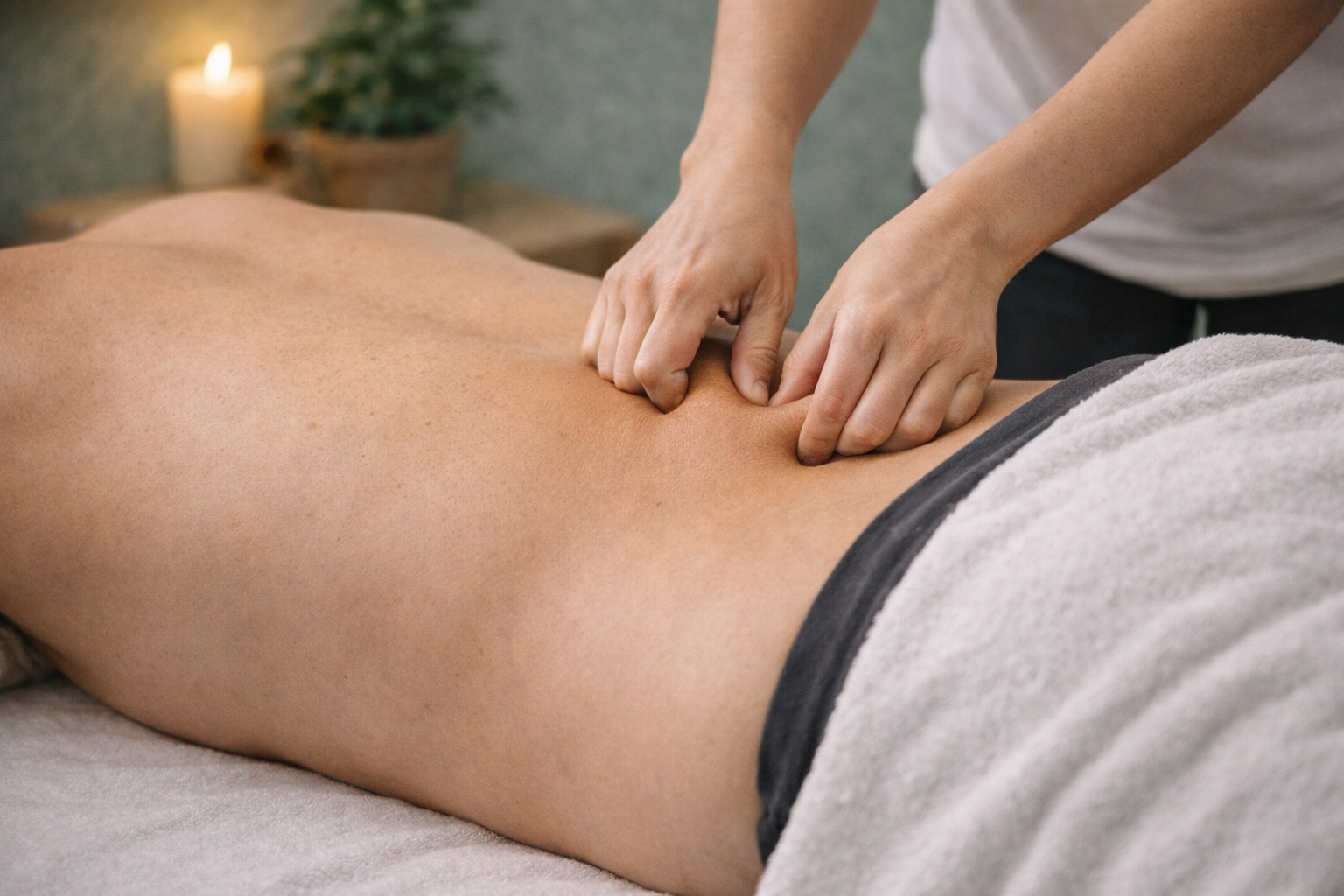
At Easy Cozy in Nanaimo, recurring back pain is one of the most common presentations we treat, and one of the most satisfying, because the five-cause model gives us a clear treatment target at each session. Sessions begin with an assessment identifying which of the five causes are most active: which trigger points are present, what movement compensation patterns are visible, and which muscle groups are most involved in the current episode.
Treatment combines deep tissue massage on the lumbar erectors, QL and hip flexors with acupressure on the established trigger points. According to Health Canada's published evidence on musculoskeletal care, massage therapy is a recognised evidence-supported intervention for non-specific low back pain, with particular effectiveness when directed at the underlying myofascial components rather than the acute symptom (Government of Canada, 2024: https://www.canada.ca/en/health-canada.html). No referral needed, no waitlist.
Now that you understand what is driving your recurring back pain, the next step is easy. Book a session at Easy Cozy, we will address the pattern, not just the episode.
Book Now: https://easycozy.ca/booking
Frequently asked questions
Why does my back pain keep coming back even after it heals?
Recurring back pain returns because the underlying causes, muscle imbalance, established trigger points, central sensitisation, compensatory movement patterns, and incomplete recovery, were not addressed during the pain-free period. Rest resolves the acute inflammation but leaves all five foundational causes intact and ready to produce the next episode when triggered.
How many times can back pain come back before it becomes chronic?
There is no fixed number, but the clinical threshold for chronic back pain is pain that has been present for more than 12 weeks, or recurring pain where episodes are becoming more frequent and more severe. At this point, central sensitisation is typically established and the pattern requires more than rest to break. Professional treatment is strongly recommended before the pattern becomes further entrenched.
Is massage effective for recurring back pain?
Yes, particularly when targeted at the specific muscles and trigger points driving the recurrence pattern. Massage addresses three of the five causes of recurring back pain directly: trigger point deactivation, hip flexor lengthening, and reduction of the central sensitisation component through parasympathetic nervous system activation. Combined with self-management between sessions, massage produces significantly longer pain-free periods for most people with recurring back pain.
Why does my back hurt every day even when I am not doing anything strenuous?
Daily back pain without an obvious physical trigger is almost always driven by the combination of established trigger points and central sensitisation. The trigger points generate a continuous low-level pain signal. Central sensitisation amplifies it to the point where it is noticed even in the absence of loading or movement. This pattern requires hands-on treatment targeting the trigger points, not rest or pain management alone.
Final Suggestion
If you’re looking for massage therapy in Nanaimo that helps you feel relaxed, refreshed, and back to your best, Easy Cozy Wellness is here to help.
We focus on real results, not just temporary relief. Whether you’re dealing with daily tension, chronic discomfort, or simply need time to unwind, our treatments are designed to support your body and your overall well-being.
We regularly help clients with:
Sciatic pain (sciatica)
Hip pain
Knee pain
Elbow pain (tennis elbow, golfer’s elbow)
Leg pain and muscle tightness
Foot pain and plantar fasciitis
Hand and wrist pain (including carpal tunnel symptoms)
Joint pain and inflammation
Muscle soreness and post-workout recovery
Chronic pain conditions
Nerve pain and tension
Upper back and mid-back pain
Glute pain and piriformis syndrome
Calf tightness and strain
Shin splints
Ankle pain and mobility issues
Postural pain from sitting or desk work
Repetitive strain injuries (RSI)
Stress, tension, and fatigue
Our services include:
Relaxation massage
Deep tissue massage
Therapeutic massage
Pain relief massage
Stress relief treatments
Wellness and recovery sessions
Preventative body care
At Easy Cozy Wellness, the goal is simple. Help your body feel better, move better, and recover faster.
If you’ve been searching for:
massage therapy Nanaimo
best massage Nanaimo
affordable massage Nanaimo
deep tissue massage Nanaimo
relaxation massage Nanaimo
pain relief massage Nanaimo
wellness clinic Nanaimo
You’re in the right place.
Give us a call at 778-561-0208 and book your next wellness appointment today.
Or visit https://easycozy.ca/ to learn more about our services, see current offers, and review our satisfaction guarantee.
We’re proud to offer a more affordable option compared to many local providers, without compromising on quality or results.
Once you experience the difference, you’ll understand why so many people choose Easy Cozy Wellness for ongoing care.
You can schedule your massage appointment here:
Relaxation is not a luxury — it’s an essential part of staying healthy and energized.
Your body will thank you. Talk soon.

