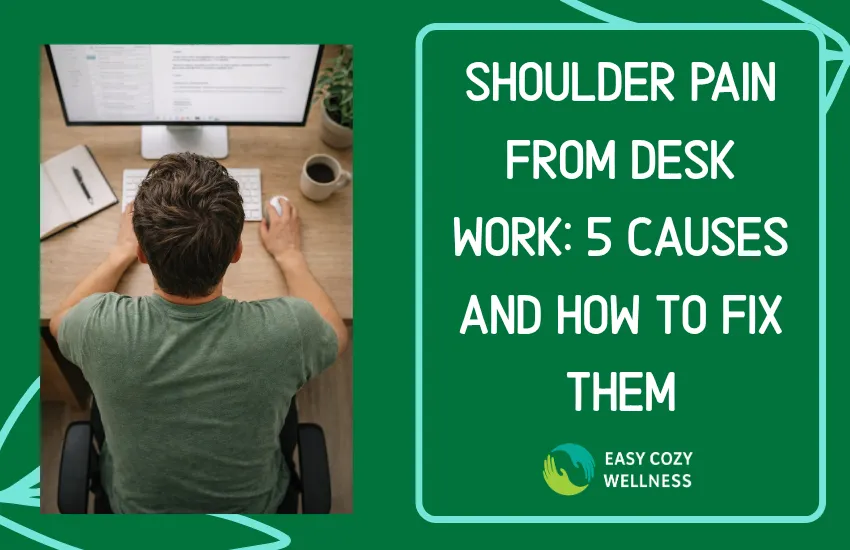
Shoulder Pain From Desk Work: 5 Real Causes and How to Fix Them
Shoulder Pain From Desk Work: 5 Causes and How to Fix Them
Shoulder pain from desk work follows a predictable pattern, and once you understand it, the relief becomes much more targeted and lasting. The pain is not caused by one thing. It is caused by a specific set of overlapping muscle overloads that accumulate over months of sustained desk posture, and each one contributes to a different part of the pain you feel.
The 5 causes of shoulder pain from desk work
Desk-related shoulder pain is one of the most prevalent occupational health complaints in Canada. According to Statistics Canada, musculoskeletal disorders, including neck and shoulder pain, account for the largest proportion of work-related injuries among office workers, with screen-based work identified as a primary contributing factor (Statistics Canada, 2024: https://www.statcan.gc.ca/en/start).
1. Sustained shoulder elevation
When you type, your arms are held slightly forward and your shoulders tend to rise, often unconsciously. Holding this position for hours keeps the upper trapezius in a state of constant low-level contraction. Over weeks and months, the muscle develops trigger points: tight, hypersensitive knots that cause the familiar aching across the top of the shoulders and into the base of the neck.
2. Mouse arm overuse
The arm holding the mouse is extended away from the body, requiring the deltoid and rotator cuff muscles to maintain a sustained, low-level contraction. The supraspinatus, one of the four rotator cuff muscles, is particularly susceptible to this kind of overuse. Sustained supraspinatus loading causes the dull ache felt deep in the shoulder, often around the top of the arm.
3. Protracted scapula position
Reaching forward to a keyboard or mouse causes the shoulder blades to move outward and forward, a position called protraction. Sustained scapular protraction lengthens and weakens the rhomboids and middle trapezius, the muscles responsible for pulling the shoulder blades back. These lengthened muscles fatigue easily and produce the burning sensation felt between the shoulder blades after a long day at a desk.
4. Forward head position
For every centimetre the head moves forward of the shoulders, the effective load on the cervical spine and upper shoulder muscles increases by approximately 4.5kg. According to Physiopedia, forward head posture is directly associated with upper trapezius and levator scapulae overactivation, the two muscles most responsible for desk-related shoulder and neck pain (Physiopedia, 2024: https://www.physio-pedia.com/Forward_Head_Posture). This overactivation produces the tightness running from the top of the shoulder up into the neck.
5. Reduced thoracic mobility
Long periods of sitting with a rounded upper back reduce the mobility of the thoracic spine. When the thoracic spine cannot move freely, the shoulder joint compensates, taking on additional range-of-motion demands it was not designed to carry. This compensatory overuse produces fatigue and pain in the shoulder muscles over time, particularly during movements that require overhead reach or rotation.
Why desk-related shoulder pain gets worse over time
Each of the five causes above operates through the same underlying mechanism: sustained overload creates trigger points, trigger points create pain, pain creates protective muscle guarding, and guarding creates more overload. The cycle is self-perpetuating.
This progressive worsening is why how to fix shoulder pain from desk job approaches that only address symptoms rather than the underlying muscle patterns consistently fail to produce lasting results.
What actually helps (and what does not)
What helps
Shoulder blade retractions: pull shoulder blades together and down for 5 seconds, 10 repetitions hourly. This directly counters scapular protraction and deactivates the sustained upper trapezius contraction.
Doorframe chest stretch: stand in a doorway with both arms at 90 degrees, step forward gently. Holds for 30 seconds reverse the pectoral shortening that contributes to scapular protraction.
Desk setup correction: screen at eye level, mouse close to the body, elbows at 90 degrees and close to the trunk. This is the single most impactful long-term change.
Targeted massage on the upper trapezius, levator scapulae, supraspinatus and rhomboids, the four muscles most involved in desk-related shoulder pain.
What does not help
General foam rolling of the upper back: too non-specific to deactivate individual trigger points.
Shoulder shrugs as a stretch: the upper trapezius is already overactive, shrugging further loads it.
Rest alone: the trigger points do not release through inactivity.
The NHS guidance on work-related shoulder pain confirms that active treatment targeting the specific overloaded muscles is significantly more effective than rest or general movement for desk-related musculoskeletal conditions (NHS, 2024: https://www.nhs.uk/conditions/shoulder-pain/).
When to get professional help
Desk-related shoulder pain that has been building for more than two to three weeks, or that has not responded to the corrections above, warrants professional treatment. See a GP before booking massage if:
Pain radiates down the arm past the elbow
Shoulder pain is accompanied by numbness or tingling in the hand or fingers
You cannot lift the arm above shoulder height without significant pain
The pain started after a fall, direct impact or sudden movement
If none of those apply, targeted massage therapy is an appropriate and effective first step.

Shoulder and neck pain from desk work in Nanaimo
At Easy Cozy in Nanaimo, shoulder and neck pain from working at a desk is one of the most common presentations we treat. Sessions are structured around the five specific muscles identified in this post, upper trapezius, levator scapulae, supraspinatus, rhomboids, and the pectorals that contribute to scapular protraction, rather than a generalised shoulder massage.
Acupressure is particularly effective for the deep supraspinatus and levator trigger points that standard massage often cannot fully reach. Many clients who have tried other forms of shoulder treatment without lasting results find that targeted acupressure on these specific structures produces a noticeably different response. No referral needed and no waitlist, most sessions are available within the same week.
Now that you understand what is driving your shoulder pain, the next step is easy. Book a session at Easy Cozy, we specialise in exactly this.
Book Now: https://easycozy.ca/booking
Frequently asked questions
Why do I get shoulder pain from sitting at a desk all day?
Desk-related shoulder pain is caused by five overlapping mechanisms: sustained shoulder elevation while typing, mouse arm overuse loading the rotator cuff, forward scapula position weakening the rhomboids, forward head position overloading the upper trapezius, and reduced thoracic mobility forcing the shoulder joint to compensate. Most people have several of these happening simultaneously after months of desk work.
How long does it take for desk-related shoulder pain to improve?
With targeted massage treating the specific muscles involved, most people notice meaningful relief within one to two sessions. Making the desk setup corrections described in this post, screen height, mouse position, elbow angle, simultaneously prevents the reloading that would otherwise reverse the treatment benefit. Without these changes, the pain typically returns within a week of treatment.
Is massage effective for shoulder pain from computer work?
Yes, targeted massage addressing the upper trapezius, levator scapulae, supraspinatus and rhomboids is one of the most effective treatments for desk-related shoulder pain. The key word is targeted: general shoulder massage that does not identify and treat the specific trigger points driving the pain will produce less consistent results than assessment-led treatment addressing the specific structures involved.
Can I fix shoulder pain from desk work myself?
Self-management, posture corrections, desk setup changes, shoulder retractions and targeted stretching, can halt the progression of desk-related shoulder pain and provide meaningful relief for early-stage presentations. Once trigger points are established and the pain has been present for more than a few weeks, professional massage treatment produces faster and more complete results than self-management alone.
Final Suggestion
If you’re looking for massage therapy in Nanaimo that helps you feel relaxed, refreshed, and back to your best, Easy Cozy Wellness is here to help.
We focus on real results, not just temporary relief. Whether you’re dealing with daily tension, chronic discomfort, or simply need time to unwind, our treatments are designed to support your body and your overall well-being.
We regularly help clients with:
Sciatic pain (sciatica)
Hip pain
Knee pain
Elbow pain (tennis elbow, golfer’s elbow)
Leg pain and muscle tightness
Foot pain and plantar fasciitis
Hand and wrist pain (including carpal tunnel symptoms)
Joint pain and inflammation
Muscle soreness and post-workout recovery
Chronic pain conditions
Nerve pain and tension
Upper back and mid-back pain
Glute pain and piriformis syndrome
Calf tightness and strain
Shin splints
Ankle pain and mobility issues
Postural pain from sitting or desk work
Repetitive strain injuries (RSI)
Stress, tension, and fatigue
Our services include:
Relaxation massage
Deep tissue massage
Therapeutic massage
Pain relief massage
Stress relief treatments
Wellness and recovery sessions
Preventative body care
At Easy Cozy Wellness, the goal is simple. Help your body feel better, move better, and recover faster.
If you’ve been searching for:
massage therapy Nanaimo
best massage Nanaimo
affordable massage Nanaimo
deep tissue massage Nanaimo
relaxation massage Nanaimo
pain relief massage Nanaimo
wellness clinic Nanaimo
You’re in the right place.
Give us a call at 778-561-0208 and book your next wellness appointment today.
Or visit https://easycozy.ca/ to learn more about our services, see current offers, and review our satisfaction guarantee.We’re proud to offer a more affordable option compared to many local providers, without compromising on quality or results.
Once you experience the difference, you’ll understand why so many people choose Easy Cozy Wellness for ongoing care.
You can schedule your massage appointment here:
Relaxation is not a luxury — it’s an essential part of staying healthy and energized.
Your body will thank you. Talk soon.

