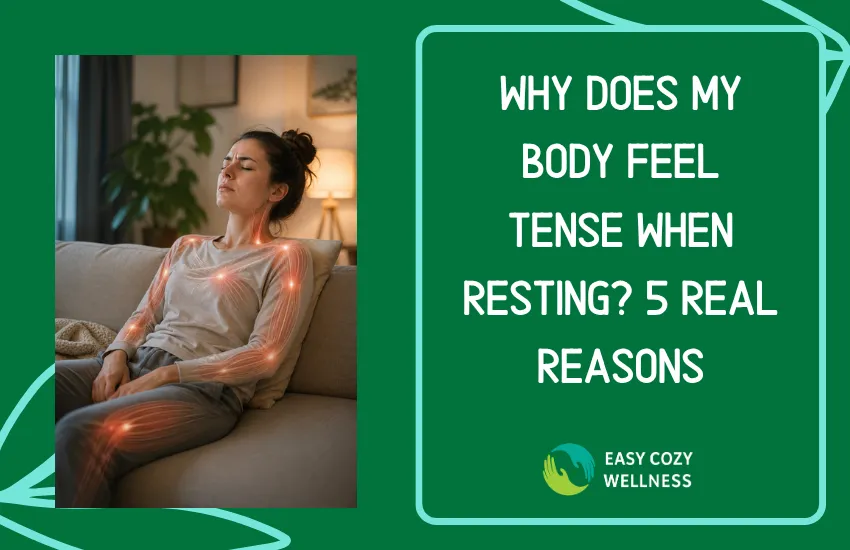
Why Does My Body Feel Tense When Resting? 5 Real Reasons
Why Does My Body Feel Tense When Resting? 5 Real Reasons
A body that feels tense when resting is not imagining it — and it is not simply a matter of trying harder to relax. The reason your body feels tense when resting comes down to five specific biological and neurological mechanisms that keep your muscles in a state of partial contraction even when you have consciously stopped all activity.
Understanding why this happens is the first step toward resolving it. Once the mechanism is clear, it becomes obvious why telling yourself to relax — without addressing the underlying drivers — does not work.
Table of contents
1. The 5 reasons your body feels tense at rest
2. Why rest alone does not release chronic tension
3. What you can do right now
4. When to get help for persistent body tension
5. Body tension relief in Nanaimo
6. Frequently asked questions

The 5 reasons your body feels tense at rest
The Cleveland Clinic identifies chronic sympathetic nervous system activation as the leading physiological cause of persistent muscle tension at rest — a state in which the fight-or-flight response remains partially engaged even during periods of inactivity, keeping muscles primed for action that never comes (Cleveland Clinic, 2024: https://my.clevelandclinic.org/health/articles/stress).
1. Chronic sympathetic nervous system activation
When you experience stress — even low-grade, ongoing stress from work demands, relationship pressure, or financial worry — your sympathetic nervous system activates a body-wide muscle-bracing response. In acute stress, this resolves when the stressor passes. In chronic stress, the sympathetic system stays partially activated indefinitely. This is the most common reason the body feels tense for no reason during rest: the nervous system is not actually at rest, even when you are horizontal.
2. Established muscle trigger points
Trigger points are tight, hypersensitive knots within muscle fibres that generate their own continuous pain and tension signals independent of any external stressor. Once established, they remain active regardless of whether you are stressed, relaxed, active or resting. This is why body tension often feels the same on a calm Sunday morning as it does during a difficult working week — the trigger points are generating the sensation continuously.
3. Cortisol dysregulation
Cortisol follows a daily rhythm: high in the morning to mobilise energy, declining through the day, lowest at night. In people with chronic stress, this rhythm is disrupted — cortisol remains elevated in the evening, preventing the physiological downshift that allows muscles to release. The always feel tense and tight muscles experience that is worst in the evening or when trying to sleep is a characteristic cortisol dysregulation pattern.
4. Breathing pattern disruption
Chronic stress shifts breathing from slow, deep, diaphragmatic breathing to fast, shallow, upper-chest breathing. Shallow breathing keeps the accessory breathing muscles — scalenes, sternocleidomastoid, upper trapezius — in a state of constant partial contraction. These muscles are designed for brief intense use, not sustained activation. Their continuous low-level contraction contributes significantly to the sense of tightness in the neck, upper shoulders and chest that persists even at rest.
5. Postural muscle fatigue
After hours of sustained sitting or desk work, the postural muscles — the lumbar erectors, cervical extensors, and upper trapezius — have been contracting isometrically for the entire working day. This sustained contraction creates metabolic fatigue and trigger point activity that persists for hours after work ends. The feeling of being unable to relax your muscles in the evening is often simply accumulated postural muscle fatigue that has not yet dissipated. [related reading: where stress is stored in the body]
Why rest alone does not release chronic tension
Rest reduces the external demands on the body but does not address any of the five mechanisms above. The sympathetic nervous system stays partially activated. Trigger points remain active. Cortisol rhythm does not reset in a single evening. Breathing patterns do not correct themselves without deliberate intervention.
This is why why cant I relax my muscles is such a common experience for people under chronic stress — because the biological state that maintains the tension is not the same as the state they are consciously trying to achieve by resting. The nervous system and the muscles need direct intervention to shift into the parasympathetic state that allows genuine release. [related reading: how stress causes physical pain]
What you can do right now
•Diaphragmatic breathing: 5 minutes of slow, belly-focused breathing activates the parasympathetic nervous system and begins to reduce sympathetic activation. This is the fastest single intervention for body tension at rest.
•Progressive muscle relaxation: deliberately tensing each muscle group for 5 seconds then releasing, working from feet to head. The deliberate contraction-release cycle interrupts the unconscious bracing pattern that chronic tension creates.
•Heat on the primary tension sites: upper trapezius, lower back or hips — whichever feels most held. Heat temporarily reduces trigger point activity and can provide enough relief to allow sleep.
•Consistent sleep and wake times: cortisol rhythm is partly entrained by the sleep-wake cycle. Irregular sleep patterns perpetuate the cortisol dysregulation that maintains evening tension.
These approaches manage the immediate experience. For body tension when relaxing that has been present for months, professional treatment directly addressing the trigger points and nervous system activation is significantly more effective than self-management alone.
When to get help for persistent body tension
Body tension that has been present daily for more than two to three weeks, that does not respond to rest or self-management, and that is affecting your sleep or quality of life warrants professional assessment. See your GP if:
•Body tension is accompanied by significant anxiety or depressive symptoms
•Tension is localised specifically in the chest and is accompanied by shortness of breath
•You are also experiencing significant changes in appetite, mood or sleep beyond what stress explains
If the tension fits the chronic-stress, postural-fatigue pattern described above, massage and acupressure directly addressing the trigger points and nervous system drivers produces relief that self-management cannot reach. According to the Canadian Mental Health Association, physical interventions including massage therapy are effective adjuncts for stress-related physical symptoms, particularly when combined with self-directed relaxation practices between sessions (CMHA, 2024: https://cmha.ca/).
Body tension relief in Nanaimo
At Easy Cozy in Nanaimo, why do my muscles feel tight all the time is one of the most common underlying complaints we treat. It presents beneath many of the primary conditions — back pain, neck pain, insomnia — and addressing it directly at the trigger point and nervous system level produces a qualitatively different result than treating the symptom alone.
Sessions combine deep tissue massage on the primary tension storage sites with acupressure on the parasympathetic activation points that shift the nervous system toward genuine rest. According to Health Canada's guidelines on complementary care for stress-related conditions, massage therapy is a safe and evidence-supported intervention for chronic muscle tension associated with stress, appropriate as a primary or adjunct treatment (Government of Canada, 2024: https://www.canada.ca/en/health-canada.html). No referral, no waitlist.
If your body feels tense even when you rest, you are not alone. Book a session at Easy Cozy and let us help you release what you have been holding.
Book Now: https://easycozy.ca/booking
Frequently asked questions
Why does my body feel tense even when I am resting?
Body tension at rest is caused by five mechanisms: chronic sympathetic nervous system activation, established muscle trigger points, cortisol rhythm disruption, shallow breathing patterns keeping accessory muscles contracted, and accumulated postural muscle fatigue. Rest reduces external demands but does not address any of these mechanisms — which is why tension persists through evenings and weekends without direct intervention.
Is it normal to feel tense all the time?
It is common but not normal. Persistent body tension is a sign that the nervous system is chronically activated beyond what the body can self-correct. Many people normalise it because it builds gradually. But the fact that tension is familiar does not mean it is healthy or inevitable. It responds well to treatment — most people who have carried chronic tension for months are surprised by how different their body can feel after targeted treatment.
How do I stop my body from feeling tense?
Diaphragmatic breathing is the fastest short-term intervention. Progressive muscle relaxation addresses the unconscious bracing pattern. For sustained relief, the trigger points and nervous system activation driving the tension need direct treatment through massage and acupressure. Self-management maintains the benefit between professional sessions but is rarely sufficient alone for tension that has been established for weeks or months.
Why can I not relax my muscles even when I try?
Because conscious relaxation attempts work on the voluntary nervous system, while chronic muscle tension operates through the involuntary sympathetic nervous system and through trigger points that generate their own continuous signals. Telling your muscles to relax does not reach either mechanism. Diaphragmatic breathing, which activates the parasympathetic system involuntarily, is more effective than conscious effort. Direct trigger point treatment is more effective still.
Final Suggestion
If you’re looking for massage therapy in Nanaimo that helps you feel relaxed, refreshed, and back to your best, Easy Cozy Wellness is here to help.
We focus on real results, not just temporary relief. Whether you’re dealing with daily tension, chronic discomfort, or simply need time to unwind, our treatments are designed to support your body and your overall well-being.
We regularly help clients with:
• Back pain
• Neck pain
• Shoulder pain
• Lower back pain
• Lumbar pain
• Headaches and migraines
• Sciatic pain (sciatica)
• Hip pain
• Knee pain
• Elbow pain (tennis elbow, golfer’s elbow)
• Leg pain and muscle tightness
• Foot pain and plantar fasciitis
• Hand and wrist pain (including carpal tunnel symptoms)
• Joint pain and inflammation
• Muscle soreness and post-workout recovery
• Chronic pain conditions
• Nerve pain and tension
• Upper back and mid-back pain
• Glute pain and piriformis syndrome
• Calf tightness and strain
• Shin splints
• Ankle pain and mobility issues
• Postural pain from sitting or desk work
• Repetitive strain injuries (RSI)
• Stress, tension, and fatigue
Our services include:
• Relaxation massage
• Deep tissue massage
• Therapeutic massage
• Pain relief massage
• Stress relief treatments
• Wellness and recovery sessions
• Preventative body care
At Easy Cozy Wellness, the goal is simple. Help your body feel better, move better, and recover faster.
If you’ve been searching for:
massage therapy Nanaimo
best massage Nanaimo
affordable massage Nanaimo
deep tissue massage Nanaimo
relaxation massage Nanaimo
pain relief massage Nanaimo
wellness clinic Nanaimo
You’re in the right place.
Give us a call at 778-561-0208 and book your next wellness appointment today.
Or learn more about our deep tissue massage in Nanaimo.
We’re proud to offer a more affordable option compared to many local providers, without compromising on quality or results.
Once you experience the difference, you’ll understand why so many people choose Easy Cozy Wellness for ongoing care.
You can schedule your massage appointment here:
Relaxation is not a luxury — it’s an essential part of staying healthy and energized.
Your body will thank you. Talk soon.

