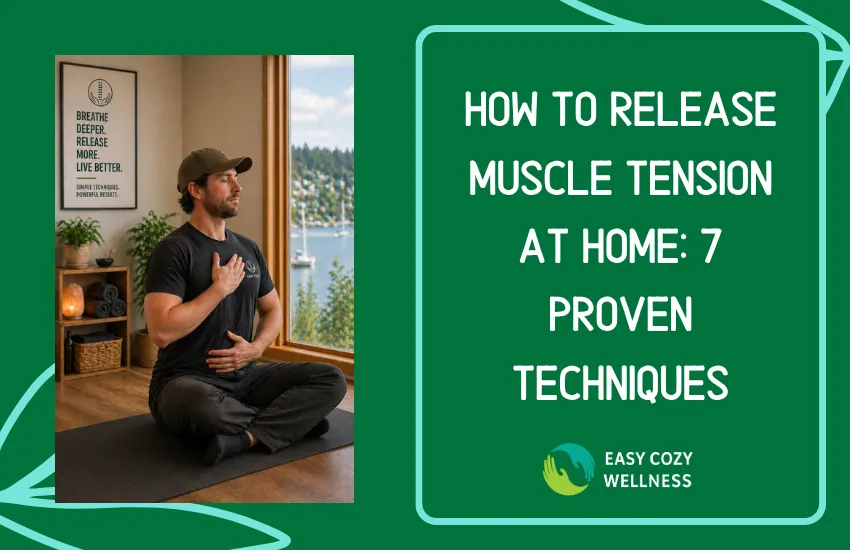
How to Release Muscle Tension at Home: 6 Proven Techniques
How to release muscle tension at home depends on whether the tension is recent and mild or established and chronic — and being honest about this distinction is important, because the techniques below work very well for the former and only partially for the latter. This post gives you the six most effective home techniques, explains why each one works, and tells you exactly where the limits of self-treatment are.
This is a guide for people who want to do as much as they can themselves — and who want to know when that is not going to be enough.
Table of contents
1. The 6 proven techniques for releasing muscle tension at home
2. How to tell if your tension is self-treatable
3. What self-treatment cannot reach
4. How to combine self-treatment with professional care for the best results
5. Muscle tension treatment in Nanaimo
6. Frequently asked questions
The 6 proven techniques for releasing muscle tension at home
According to the Cleveland Clinic, the most evidence-supported self-management techniques for muscle tension — whether stress-related or postural — combine nervous system modulation with direct mechanical intervention on the affected tissue (Cleveland Clinic, 2024: https://my.clevelandclinic.org/health/articles/stress). The six techniques below represent the best of both approaches.
1. Diaphragmatic breathing (5 minutes — immediate effect)
Place one hand on your chest and one on your belly. Breathe so that only the lower hand moves. Inhale for 4 counts, hold for 2, exhale for 6. Five minutes of this activates the parasympathetic nervous system and begins to reduce the sympathetic activation driving the tension. This is the fastest single technique and the foundation for all others — if the nervous system is still in sympathetic activation, mechanical techniques are working against resistance.
2. Progressive muscle relaxation (10 minutes — strong effect)
Starting from the feet, tense each muscle group for 5 seconds then release deliberately. Work upward through the calves, thighs, glutes, abdomen, chest, arms, shoulders, neck and face. The deliberate contraction-release cycle overrides the unconscious bracing pattern of chronic tension and teaches the nervous system what full release feels like. This technique has the strongest evidence base of any self-management approach for chronic muscle tension.
3. Heat application on primary tension sites (15-20 minutes)
Heat increases local blood flow, reduces trigger point chemical activity, and allows tense muscles to lengthen more easily. The most effective application for muscle tension from stress is sustained moist heat (a warm towel or heat pack) on the primary tension sites — upper trapezius, lower back, or wherever the tension is most concentrated. 15-20 minutes before bed is the optimal timing for sleep benefit.
4. Targeted stretching after heat (5-10 minutes)
Stretching is most effective when the tissue is warm — cold stretching produces 30-40% less lengthening than post-heat stretching. After heat application: levator scapulae stretch (looking toward armpit, 30 seconds each side), upper trapezius stretch (ear to shoulder, 30 seconds each side), and hip flexor stretch (low lunge, 45 seconds each side). Perform these immediately after heat, not before.
5. Self-massage of accessible tension areas
The upper trapezius, the base of the skull, and the neck are accessible to self-massage with reasonable effectiveness. Use two or three fingers to apply sustained pressure to tender points, holding for 60-90 seconds until the sensitivity reduces. The suboccipital muscles at the base of the skull respond particularly well to sustained pressure from fingertips placed just below the bony ridge. Self-massage for muscle tension in accessible areas provides meaningful temporary relief.
6. Consistent movement throughout the day
Movement is the most underutilised home remedy for muscle tension. Regular low-intensity movement — walking, gentle movement, standing — maintains blood flow through tense muscles, prevents metabolic waste accumulation, and keeps trigger points from consolidating. For desk workers or people with sedentary work, this means a 2-3 minute walk every 45 minutes rather than extended exercise. The cumulative effect over a working day is significant.
How to tell if your tension is self-treatable
Self-treatment is most effective when the tension is:
Recent — developed over days or a few weeks rather than months
Mild to moderate — uncomfortable but not limiting daily function
Diffuse rather than located in specific, consistent trigger points
Responding to the techniques above within 2-3 days of consistent practice
Self-treatment is likely insufficient if the tension is:
Chronic — present daily for more than 4-6 weeks
Located in specific, consistently tender trigger points that do not change with self-treatment
Affecting sleep, daily function or mood
Not responding to the techniques above after a week of consistent practice
What self-treatment cannot reach
Self-treatment has one fundamental limitation: you cannot apply adequate pressure to your own back, the medial scapular border, or the deep hip flexors. These are the areas where the most significant chronic tension accumulates, and they require a practitioner to reach effectively.
Established trigger points in the rhomboids, levator scapulae, and iliacus require sustained, directed pressure at a depth and angle that cannot be achieved through self-massage. How to relax tense muscles fast when they are in these locations means professional treatment — not because self-care is inadequate in general, but because the anatomy does not allow you to reach these specific structures yourself. [related reading: how stress causes physical pain]
According to the Canadian Mental Health Association, self-directed relaxation techniques are effective for managing the nervous system component of stress-related tension, but professional manual therapy is recommended for the established myofascial component — particularly when tension has been present for more than 4-6 weeks (CMHA, 2024: https://cmha.ca/).
How to combine self-treatment with professional care for the best results
The most effective approach uses self-treatment and professional care for different functions rather than as alternatives to each other:
Self-treatment prevents re-accumulation between professional sessions — particularly diaphragmatic breathing, progressive muscle relaxation, and heat application.
Professional massage clears the established trigger points and fascial restrictions that self-treatment cannot reach.
Combined, this approach produces faster results than professional treatment alone and more complete results than self-treatment alone.
For when muscle tension is too much to treat yourself, the practical indicator is whether the tension is significantly affecting daily life and whether 7 days of consistent self-treatment has produced meaningful improvement. If neither, professional treatment is the faster and more complete option. [related reading: where stress is stored in the body]
Muscle tension treatment in Nanaimo
At Easy Cozy in Nanaimo, muscle tension from stress is one of the most commonly treated presentations. Sessions begin where self-treatment ends: identifying the specific trigger points and fascial restrictions that the techniques above cannot fully address, and applying direct, targeted treatment to those structures.
The combination of deep tissue massage on the primary tension storage sites and acupressure on the nervous system regulation points produces a qualitatively different release than self-treatment — particularly for the iliacus, QL, and deep cervical trigger points that are anatomically inaccessible without a practitioner. According to the NHS guidance on musculoskeletal pain management, manual therapy combined with self-management advice produces significantly better outcomes than self-management alone for established muscle tension (NHS, 2024: https://www.nhs.uk/live-well/exercise/back-exercises-and-stretches/). No referral needed.
When self-care is not enough — book a session at Easy Cozy. We will treat the tension that your home techniques cannot reach and give you a personalised self-care plan to maintain the result.
Book Now: https://easycozy.ca/booking
Frequently asked questions
How do I release muscle tension at home fast?
The fastest home techniques for releasing muscle tension are: diaphragmatic breathing (5 minutes, immediate nervous system effect), heat application to the primary tension site (15 minutes), followed by targeted stretching of the affected muscles while warm. Combining all three in sequence — breathing, then heat, then stretch — produces the fastest meaningful relief that home treatment can achieve. Progressive muscle relaxation is the most evidence-supported longer-format technique.
Does self-massage help with muscle tension?
Self-massage is effective for accessible areas — upper trapezius, base of skull, neck, forearms. Applying sustained pressure (60-90 seconds) to specific tender trigger points produces genuine deactivation. However, the most significant tension storage sites — the rhomboids, iliacus, deep cervical muscles, and QL — cannot be adequately reached through self-massage. For these areas, professional treatment is required.
How long does it take to release chronic muscle tension?
For recent tension of a few days or weeks, consistent daily self-treatment typically produces significant relief within 5-7 days. For chronic tension established over months, professional massage sessions are required to clear the established trigger points, with self-treatment maintaining the results between sessions. A course of two to four professional sessions combined with daily self-care produces the most complete resolution for most people.
When should I see a professional for muscle tension instead of treating it myself?
See a professional when: the tension has been present daily for more than 4-6 weeks; it is significantly affecting sleep, daily function or mood; it is located in specific consistent trigger points that do not change with self-treatment; or you have practised the home techniques consistently for 7 days without meaningful improvement. Professional treatment reaches the tissue depth and neural pathways that home techniques cannot.
Final Suggestion
If you’re looking for massage therapy in Nanaimo that helps you feel relaxed, refreshed, and back to your best, Easy Cozy Wellness is here to help.
We focus on real results, not just temporary relief. Whether you’re dealing with daily tension, chronic discomfort, or simply need time to unwind, our treatments are designed to support your body and your overall well-being.
We regularly help clients with:
• Back pain
• Neck pain
• Shoulder pain
• Lower back pain
• Lumbar pain
• Headaches and migraines
• Sciatic pain (sciatica)
• Hip pain
• Knee pain
• Elbow pain (tennis elbow, golfer’s elbow)
• Leg pain and muscle tightness
• Foot pain and plantar fasciitis
• Hand and wrist pain (including carpal tunnel symptoms)
• Joint pain and inflammation
• Muscle soreness and post-workout recovery
• Chronic pain conditions
• Nerve pain and tension
• Upper back and mid-back pain
• Glute pain and piriformis syndrome
• Calf tightness and strain
• Shin splints
• Ankle pain and mobility issues
• Postural pain from sitting or desk work
• Repetitive strain injuries (RSI)
• Stress, tension, and fatigue
Our services include:
• Relaxation massage
• Deep tissue massage
• Therapeutic massage
• Pain relief massage
• Stress relief treatments
• Wellness and recovery sessions
• Preventative body care
At Easy Cozy Wellness, the goal is simple. Help your body feel better, move better, and recover faster.
If you’ve been searching for:
massage therapy Nanaimo
best massage Nanaimo
affordable massage Nanaimo
deep tissue massage Nanaimo
relaxation massage Nanaimo
pain relief massage Nanaimo
wellness clinic Nanaimo
You’re in the right place.
Give us a call at 778-561-0208 and book your next wellness appointment today.
Or learn more about our deep tissue massage in Nanaimo.
We’re proud to offer a more affordable option compared to many local providers, without compromising on quality or results.
Once you experience the difference, you’ll understand why so many people choose Easy Cozy Wellness for ongoing care.
You can schedule your massage appointment here:
Relaxation is not a luxury — it’s an essential part of staying healthy and energized.
Your body will thank you. Talk soon.

