Hip Tightness Causing Lower Back Pain: 5 Real Reasons
Hip Tightness Causing Lower Back Pain: 5 Real Reasons
Hip tightness causing lower back pain is one of the most commonly missed connections in musculoskeletal health: the hips and lower back share structural and neurological pathways so directly that tension in one area reliably creates pain in the other. Once you understand how the hip-back chain works, the reason your back pain persists despite treating only the back becomes clear.
This post explains the five specific mechanisms through which tight hips drive lower back pain, which hip muscles are most involved, and what treatment addresses the full chain rather than just the symptom.
Table of contents
1. The hip-back connection: why they affect each other
2. The 5 mechanisms of hip tightness causing lower back pain
3. Which hip muscles are most responsible
4. How to tell if your back pain has a hip component
5. What treatment addresses the hip-back chain
6. Hip and back pain treatment in Nanaimo
7. Frequently asked questions
The hip-back connection: why they affect each other
The hips and lumbar spine are connected through three anatomical bridges: shared muscles that attach to both structures, shared fascia that transmits tension across both regions, and shared neural pathways that regulate pain and movement in both areas. According to Physiopedia, the lumbopelvic hip complex functions as a single unit in movement and load-bearing, meaning that restriction in any one structure produces compensatory loading in the others.
This is why treating only the lower back for back pain that has a significant hip component produces temporary relief that does not hold. The tissue driving the problem is upstream in the hip chain, and it continues loading the lumbar spine regardless of how much direct lumbar treatment is applied.
The 5 mechanisms of hip tightness causing lower back pain
1. Anterior pelvic tilt from shortened hip flexors
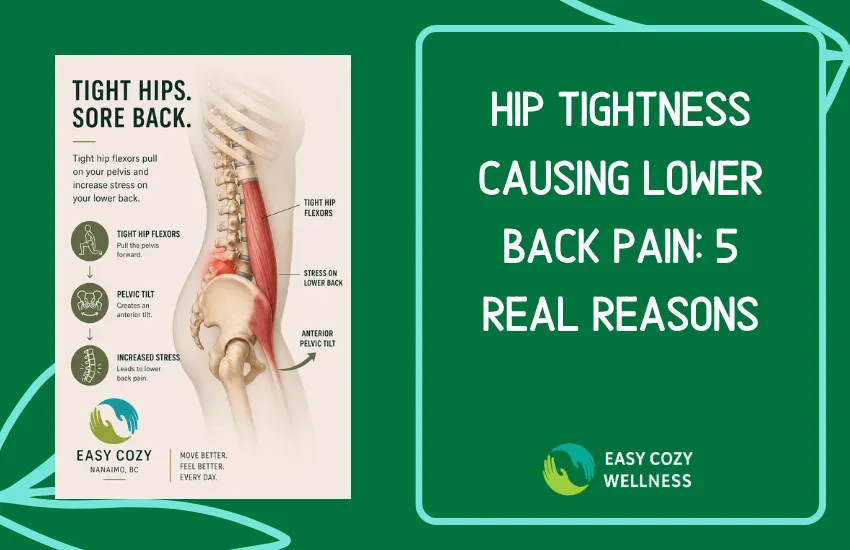
The hip flexors, particularly the psoas and iliacus, attach directly to the lumbar vertebrae and the inner surface of the pelvis. When these muscles shorten from prolonged sitting, they pull the pelvis forward into anterior tilt. Anterior pelvic tilt compresses the posterior lumbar facet joints and increases lumbar lordosis, creating the characteristic lower back ache that office workers experience as the day progresses. Tight hip flexors are the most common single cause of hip and lower back pain in sedentary adults.
2. Piriformis tightness and sciatic referral
The piriformis muscle sits deep in the gluteal region and stabilises the hip in external rotation. When it tightens, it can compress the sciatic nerve as it exits the greater sciatic foramen, producing the referral pattern often described as sciatica: a deep ache in the gluteal region that radiates down the back of the leg. This piriformis-driven referral is frequently misidentified as disc-related sciatica, though the mechanism and treatment are different.
3. Gluteal inhibition shifting load to the lumbar spine
Tight hip flexors and hip external rotators reciprocally inhibit the gluteal muscles, reducing their capacity to generate force. When the glutes are inhibited, the lumbar erectors and QL take over the stabilisation role they cannot perform. This compensatory overload is the reason that tight hips cause back pain even in people who are not particularly weak in the lower back: the hip restriction has created an upstream loading problem that the back muscles must absorb.
4. Iliotibial band tension transmitting up the kinetic chain
The iliotibial band (IT band) runs from the hip to the knee and is connected superiorly to the tensor fascia latae and gluteus maximus. Sustained IT band tightness creates lateral tension through the hip that transmits upward into the QL and lumbar fascia. This fascial transmission pathway explains why some lower back pain has a distinctly lateral quality and why direct lumbar treatment does not fully address it without releasing the hip and IT band tension that is maintaining it.
5. Thoracolumbar fascia loading from restricted hip extension
The thoracolumbar fascia connects the lower back to the pelvis and hips in a continuous sheet. When hip extension is restricted, the thoracolumbar fascia is held in a shortened position on the side of restriction. This fascial loading creates a pulling sensation in the lower back that is often interpreted as muscle pain but is actually driven by fascial tension originating at the hip. Direct hip extension release, including psoas and hip flexor work, is required to resolve this component. [related reading: how posture causes back pain]
Which hip muscles are most responsible
In clinical practice, the hip muscles most commonly involved in driving lower back pain are:
Psoas and iliacus (hip flexors): the most impactful on lumbar compression and anterior pelvic tilt. Deep and difficult to reach with standard massage; acupressure at specific iliacus release points is particularly effective.
Piriformis: responsible for the gluteal aching and sciatic referral pattern. Located deep in the gluteal region, requiring sustained targeted pressure to fully release.
Tensor fascia latae: connected to the IT band; tight TFL creates lateral hip and lower back tension.
Gluteus medius: often weak and tight simultaneously; contributes to the lateral pelvic instability that increases lumbar loading.
How to tell if your back pain has a hip component
Hip-driven back pain tends to have the following characteristics:
The pain is worse after prolonged sitting and improves briefly when standing before worsening again.
You notice stiffness in the front of the hip or groin when standing up from sitting.
One side of the lower back is tighter than the other, corresponding to a dominant side of hip tightness.
The lower back pain is accompanied by a deep gluteal ache or a sensation that runs into the back of the hip.
Lower back stretches provide temporary relief but the tightness returns quickly.
According to the NHS, lower back pain with a hip mobility component is one of the most commonly undertreated presentations in primary care, as examination often focuses on the lumbar spine without assessing hip range of motion and muscle tightness in the surrounding musculature (NHS, 2024: https://www.nhs.uk/conditions/back-pain/).
What treatment addresses the hip-back chain
Hip flexor release: targeted massage and acupressure on the psoas, iliacus and rectus femoris. The iliacus, in particular, requires access through the lower abdomen or specific acupressure points that standard back massage cannot reach.
Piriformis release: sustained pressure at the piriformis trigger points in the deep gluteal region. Acupressure at GB 30 is particularly effective for this structure.
IT band and TFL release: sustained pressure along the lateral hip and thigh to reduce the upstream loading on the lower back.
Daily hip flexor stretching: low lunge position, 45 seconds each side, daily. The single most impactful self-care step for hip-driven back pain.
Glute activation: slow glute bridges, 10 repetitions twice daily, to restore the gluteal support that hip tightness has inhibited.
According to Statistics Canada, lower back pain is the leading cause of disability among working-age Canadians, and musculoskeletal conditions involving the hip-lumbar complex represent a significant proportion of these cases (Statistics Canada, 2024: https://www.statcan.gc.ca/en/start). [related reading: why back pain keep coming back]
Hip and back pain treatment in Nanaimo
At Easy Cozy in Nanaimo, every back pain assessment includes evaluation of the hip-back chain. Many clients who have had direct lumbar treatment elsewhere without lasting results find that addressing the hip component produces a qualitatively different outcome. Sessions combine deep tissue massage on the lumbar region with targeted psoas, iliacus and piriformis release using acupressure at the specific points that reach these deep structures.
The treatment genuinely addresses the full chain: not just the site of the pain, but the upstream source of the loading that is maintaining it. No referral needed and no waitlist.
Now that you understand the hip-back connection, the next step is targeted treatment that addresses both sides of it. Book a session at Easy Cozy.
Book Now: https://easycozy.ca/booking
Frequently asked questions
Can tight hips cause lower back pain?
Yes, through five mechanisms: anterior pelvic tilt from shortened hip flexors compressing the lumbar spine, piriformis tightness producing sciatic referral, gluteal inhibition shifting load to the lumbar erectors, IT band tension transmitting up the kinetic chain, and thoracolumbar fascia loading from restricted hip extension. Most people with recurring lower back pain have at least two of these operating simultaneously.
How do I know if my back pain is coming from my hips?
Hip-driven back pain is typically worse after prolonged sitting, accompanied by stiffness in the front of the hip when standing up, located on one side more than the other, and accompanied by a deep gluteal ache. Lower back stretches provide temporary relief that does not hold, because the source of the loading is in the hip muscles rather than the lumbar structures directly.
What stretches help with hip tightness and lower back pain?
The most effective stretch for hip-driven lower back pain is the low lunge hip flexor stretch: one knee on the floor, the other foot forward, gently pressing the hips forward until a stretch is felt at the front of the back hip. Hold 45 seconds each side, twice daily. This directly addresses the psoas and iliacus shortening that is the primary driver of anterior pelvic tilt and lumbar compression.
Does massage help with hip tightness causing back pain?
Yes, particularly when the massage targets the hip flexors, piriformis and IT band in addition to the lumbar muscles. Standard back massage that does not address the hip component provides temporary relief without reaching the source. Acupressure at specific hip release points, particularly the iliacus and piriformis, produces deeper and more lasting release of the hip tension driving the back pain.
Final Suggestion
If you’re looking for massage therapy in Nanaimo that helps you feel relaxed, refreshed, and back to your best, Easy Cozy Wellness is here to help.
We focus on real results, not just temporary relief. Whether you’re dealing with daily tension, chronic discomfort, or simply need time to unwind, our treatments are designed to support your body and your overall well-being.
We regularly help clients with:
• Back pain
• Neck pain
• Shoulder pain
• Lower back pain
• Lumbar pain
• Headaches and migraines
• Sciatic pain (sciatica)
• Hip pain
• Knee pain
• Elbow pain (tennis elbow, golfer’s elbow)
• Leg pain and muscle tightness
• Foot pain and plantar fasciitis
• Hand and wrist pain (including carpal tunnel symptoms)
• Joint pain and inflammation
• Muscle soreness and post-workout recovery
• Chronic pain conditions
• Nerve pain and tension
• Upper back and mid-back pain
• Glute pain and piriformis syndrome
• Calf tightness and strain
• Shin splints
• Ankle pain and mobility issues
• Postural pain from sitting or desk work
• Repetitive strain injuries (RSI)
• Stress, tension, and fatigue
Our services include:
• Relaxation massage
• Deep tissue massage
• Therapeutic massage
• Pain relief massage
• Stress relief treatments
• Wellness and recovery sessions
• Preventative body care
At Easy Cozy Wellness, the goal is simple. Help your body feel better, move better, and recover faster.
If you’ve been searching for:
massage therapy Nanaimo
best massage Nanaimo
affordable massage Nanaimo
deep tissue massage Nanaimo
relaxation massage Nanaimo
pain relief massage Nanaimo
wellness clinic Nanaimo
You’re in the right place.
Give us a call at 778-561-0208 and book your next wellness appointment today.
Or learn more about our lower back pain massage in Nanaimo.
We’re proud to offer a more affordable option compared to many local providers, without compromising on quality or results.
Once you experience the difference, you’ll understand why so many people choose Easy Cozy Wellness for ongoing care.
You can schedule your massage appointment here:
Relaxation is not a luxury — it’s an essential part of staying healthy and energized.
Your body will thank you. Talk soon.

