How Poor Posture Causes Back Pain: 5 Proven Mechanisms
How Poor Posture Causes Back Pain: 5 Proven Mechanisms
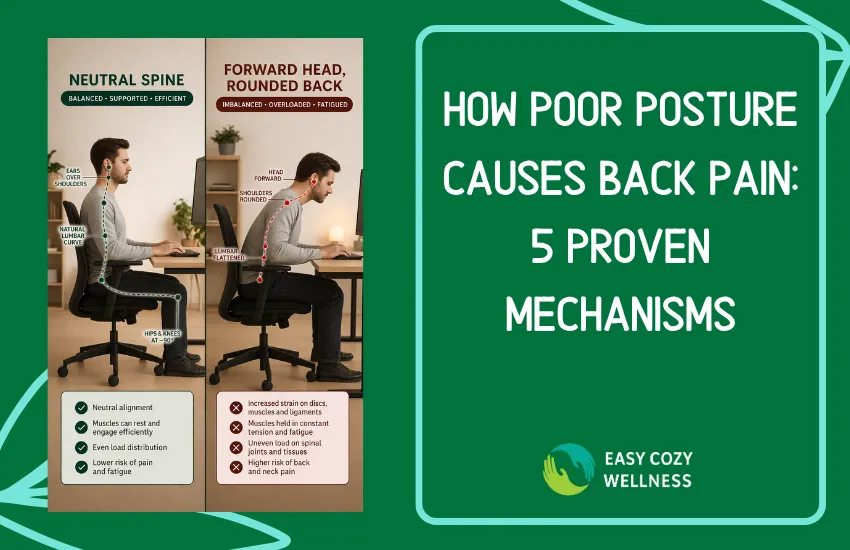
Poor posture causes back pain through five specific mechanical and neurological mechanisms, and simply telling yourself to "sit up straighter" addresses none of them. Understanding what is actually happening inside the spine and muscles when posture deteriorates explains why posture-related back pain tends to accumulate gradually and why it requires more than awareness to resolve.
New Blog Post
How Poor Posture Causes Back Pain: 5 Proven Mechanisms
The 5 mechanisms: how posture causes back pain
1. Lumbar disc compression and dehydration
4. Hip flexor shortening and pelvis tilt
5. Thoracic kyphosis and load redistribution
Why posture gets worse over time
The posture-pain feedback loop
What actually corrects posture-related back pain
Posture and back pain treatment in Nanaimo
Can poor posture cause back pain?
How long does it take to fix posture-related back pain?
The 5 mechanisms: how posture causes back pain
The structural consequences of poor posture are well documented. According to Physiopedia, sustained non-neutral spinal posture is one of the primary modifiable risk factors for low back pain, with prolonged sitting and forward head posture identified as the most significant contributors in occupational settings (Physiopedia, 2024: https://www.physio-pedia.com/Posture).
1. Lumbar disc compression and dehydration
The intervertebral discs depend on regular variation in compression and release, the mechanical pumping action that drives nutrient exchange and waste removal through the disc tissue. Sustained static posture, particularly sitting with a flattened lumbar curve, compresses the discs continuously without the release phase. Over years, this contributes to disc dehydration, reduced disc height and altered load distribution across the lumbar segments.
2. Sustained muscle overload
When posture deviates from a neutral alignment, the muscles responsible for stabilising the spine are forced to work continuously without adequate rest. In a seated, forward-leaning position, the deep stabilisers such as the multifidus and transverse abdominis become underactive, while larger superficial muscles, including the erector spinae, quadratus lumborum, and upper trapezius, compensate by remaining in a low-level, sustained contraction. Over time, this constant load leads to muscle fatigue, reduced circulation, and the development of trigger points. Unlike acute strain, this type of overload builds gradually, creating a persistent background tension that lowers the threshold for pain and makes even minor movements feel uncomfortable.
3. Ligament creep
Spinal ligaments, the passive stabilisers of the vertebral column, have a phenomenon called creep: when held under sustained load in a lengthened position, they gradually elongate and lose their normal tension. This happens in rounded sitting posture, where the posterior spinal ligaments are consistently held in a lengthened state. Ligament creep reduces passive spinal stability, increasing the active muscle load required to maintain upright posture, creating more muscle fatigue and pain.
4. Hip flexor shortening and pelvis tilt
Sustained sitting shortens the hip flexors, the muscles connecting the lumbar spine to the upper femur. Short hip flexors pull the pelvis into anterior tilt (forward rotation), which increases lumbar lordosis and compresses the posterior facet joints. This is the primary mechanism behind sitting posture causing back pain specifically in the lower lumbar region and the transition into the sacrum.
5. Thoracic kyphosis and load redistribution
Prolonged slumping increases the thoracic kyphotic curve. An exaggerated thoracic kyphosis shifts the body's centre of mass forward, requiring the lumbar spine to adopt a compensatory lordosis to maintain balance. This forward posture back pain pattern creates increased shear forces across the lumbar segments and compresses the posterior elements of the thoracic spine, producing mid-back pain, in addition to lower back pain.
Why posture gets worse over time
Posture deteriorates progressively for three reasons. Muscles that are habitually shortened, the chest, hip flexors, and anterior scalenes, become structurally shorter over months and years. Muscles that are habitually lengthened, the rhomboids, deep neck flexors and glutes, become progressively weaker. And the nervous system adapts: poor posture begins to feel "normal" because the proprioceptive baseline has shifted.
According to the NHS, the gradual adaptation of muscle length and strength to habitual posture is one of the reasons that posture-related back pain is persistent rather than episodic, and why advice to "just sit up straight" is insufficient without also addressing the structural changes that make neutral posture difficult to maintain (NHS, 2024: https://www.nhs.uk/conditions/back-pain/).
The posture-pain feedback loop
Once bad posture back pain symptoms are established, a feedback loop develops: pain causes further muscle guarding, which restricts movement, which prevents the postural corrections that would reduce the load, which perpetuates the pain. This loop is why posture-related back pain often seems to resist simple interventions, the pain itself is maintaining the conditions that cause it.
Breaking this loop requires addressing both sides: releasing the shortened and overloaded muscles, and addressing the postural habits that created the loading pattern.
What actually corrects posture-related back pain
Hip flexor release through massage and targeted stretching, addressing the primary driver of anterior pelvic tilt.
Upper trapezius and pectoral release, allowing the thoracic spine to extend and reducing the kyphotic load on the lumbar spine.
Rhomboid and middle trapezius activation, restoring the pulling strength that positions the shoulder blades correctly.
Chin tuck exercises, repositioning the head over the shoulders and deloading the suboccipital and cervical musculature.
Desk setup correction, screen height, monitor distance, keyboard position. These are the environmental factors that drive the postural loading and must change alongside treatment.
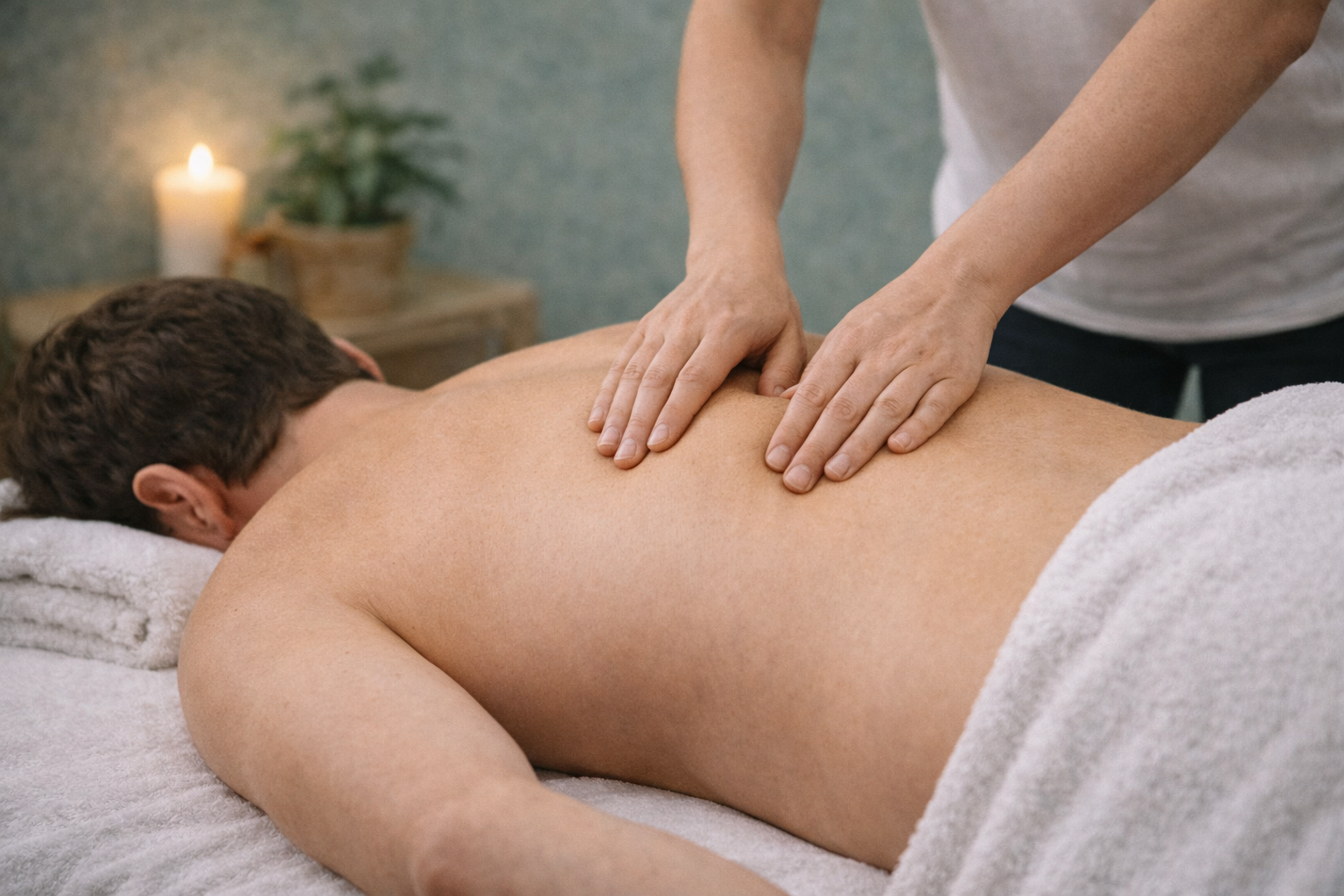
Massage and acupressure address the structural component, releasing the shortened tissues that make neutral posture mechanically difficult. Postural habit change addresses the loading component. Both are needed. For how to correct posture to relieve back pain most effectively, the combination of hands-on treatment and deliberate postural correction produces significantly faster results than either approach alone.
Posture and back pain treatment in Nanaimo
At Easy Cozy in Nanaimo, posture-related back pain is consistently among the most common presentations we treat. The five mechanisms in this post give us a clear treatment framework: assess which structures are shortened and overloaded, which are lengthened and weakened, and which postural compensations have developed as a consequence.
Sessions typically address the hip flexors, lumbar paraspinals, QL, and thoracic extensors, the primary posture-loading structures, with a combination of deep tissue massage and acupressure. According to Statistics Canada, back pain is the leading cause of disability in working-age Canadians, with poor ergonomics and prolonged sitting identified as the primary occupational risk factors (Statistics Canada, 2024: https://www.statcan.gc.ca/en/start). No referral needed, no waitlist, most sessions available within the same week.
Now that you understand how posture is driving your back pain, the next step is targeted treatment to release the structures maintaining the pattern. Book a session at Easy Cozy.
Book Now: https://easycozy.ca/booking
Frequently asked questions
Can poor posture cause back pain?
Yes, poor posture causes back pain through five specific mechanisms: disc compression, sustained muscle overload, ligament creep, hip flexor shortening and anterior pelvic tilt, and thoracic kyphosis redistributing spinal load. Most people with posture-related back pain have several of these operating simultaneously. Each mechanism is measurable and responds to targeted treatment.
How long does it take to fix posture-related back pain?
The timeline depends on how long the postural pattern has been established. Posture-related pain that has been building for a few months typically responds well within two to four massage sessions combined with consistent postural corrections. Patterns established over years of habitual sitting posture take longer but still respond to treatment, the structural changes in muscle length and strength require more consistent intervention to reverse.
Does massage help with posture-related back pain?
Yes, massage is one of the most effective treatments for posture-related back pain because it directly addresses the structural component: releasing the shortened hip flexors, chest muscles and thoracic paraspinals that make neutral posture mechanically difficult to maintain. Once these structures are released, postural correction requires significantly less conscious effort and is more sustainable long-term.
What is the best sitting posture to prevent back pain?
The most important features of a back-pain-preventive sitting posture are: lumbar support maintaining the natural inward curve of the lower back, screen at eye level to prevent forward head position, elbows at 90 degrees and close to the body, and feet flat on the floor. Equally important: no sitting posture is sustainable for more than 45-60 minutes without movement. Regular short movement breaks prevent the ligament creep and sustained muscle overload that accumulate from any static posture.
Final Suggestion
If you’re looking for massage therapy in Nanaimo that helps you feel relaxed, refreshed, and back to your best, Easy Cozy Wellness is here to help.
We focus on real results, not just temporary relief. Whether you’re dealing with daily tension, chronic discomfort, or simply need time to unwind, our treatments are designed to support your body and your overall well-being.
We regularly help clients with:
Sciatic pain (sciatica)
Hip pain
Knee pain
Elbow pain (tennis elbow, golfer’s elbow)
Leg pain and muscle tightness
Foot pain and plantar fasciitis
Hand and wrist pain (including carpal tunnel symptoms)
Joint pain and inflammation
Muscle soreness and post-workout recovery
Chronic pain conditions
Nerve pain and tension
Upper back and mid-back pain
Glute pain and piriformis syndrome
Calf tightness and strain
Shin splints
Ankle pain and mobility issues
Postural pain from sitting or desk work
Repetitive strain injuries (RSI)
Stress, tension, and fatigue
Our services include:
Relaxation massage
Deep tissue massage
Therapeutic massage
Pain relief massage
Stress relief treatments
Wellness and recovery sessions
Preventative body care
At Easy Cozy Wellness, the goal is simple. Help your body feel better, move better, and recover faster.
If you’ve been searching for:
massage therapy Nanaimo
best massage Nanaimo
affordable massage Nanaimo
deep tissue massage Nanaimo
relaxation massage Nanaimo
pain relief massage Nanaimo
wellness clinic Nanaimo
You’re in the right place.
Give us a call at 778-561-0208 and book your next wellness appointment today.
Or visit https://easycozy.ca/ to learn more about our services, see current offers, and review our satisfaction guarantee.We’re proud to offer a more affordable option compared to many local providers, without compromising on quality or results.
Once you experience the difference, you’ll understand why so many people choose Easy Cozy Wellness for ongoing care.
You can schedule your massage appointment here:
Relaxation is not a luxury — it’s an essential part of staying healthy and energized.
Your body will thank you. Talk soon.

