Massage Therapy for Athletes in Nanaimo: 5 Real Benefits
Massage Therapy for Athletes in Nanaimo: 5 Real Benefits
Massage therapy for athletes in Nanaimo delivers five specific, evidence-supported benefits that go beyond general relaxation: accelerated muscle recovery, reduced delayed onset muscle soreness, improved range of motion, better sleep quality on training nights, and reduced soft tissue injury risk. Each benefit operates through a distinct physiological mechanism and translates directly into training capacity and performance outcomes.
This post explains each benefit, what the evidence shows, and how the combination of deep tissue massage and acupressure at Easy Cozy is structured to serve the specific needs of athletes at all levels.
Table of contents
1. The 5 evidence-supported benefits of athlete massage
2. Timing: when to get massage for maximum benefit
3. What to expect from a session at Easy Cozy
4. Sports massage for specific sports in Nanaimo
5. Athlete recovery massage at Easy Cozy Nanaimo
6. Frequently asked questions
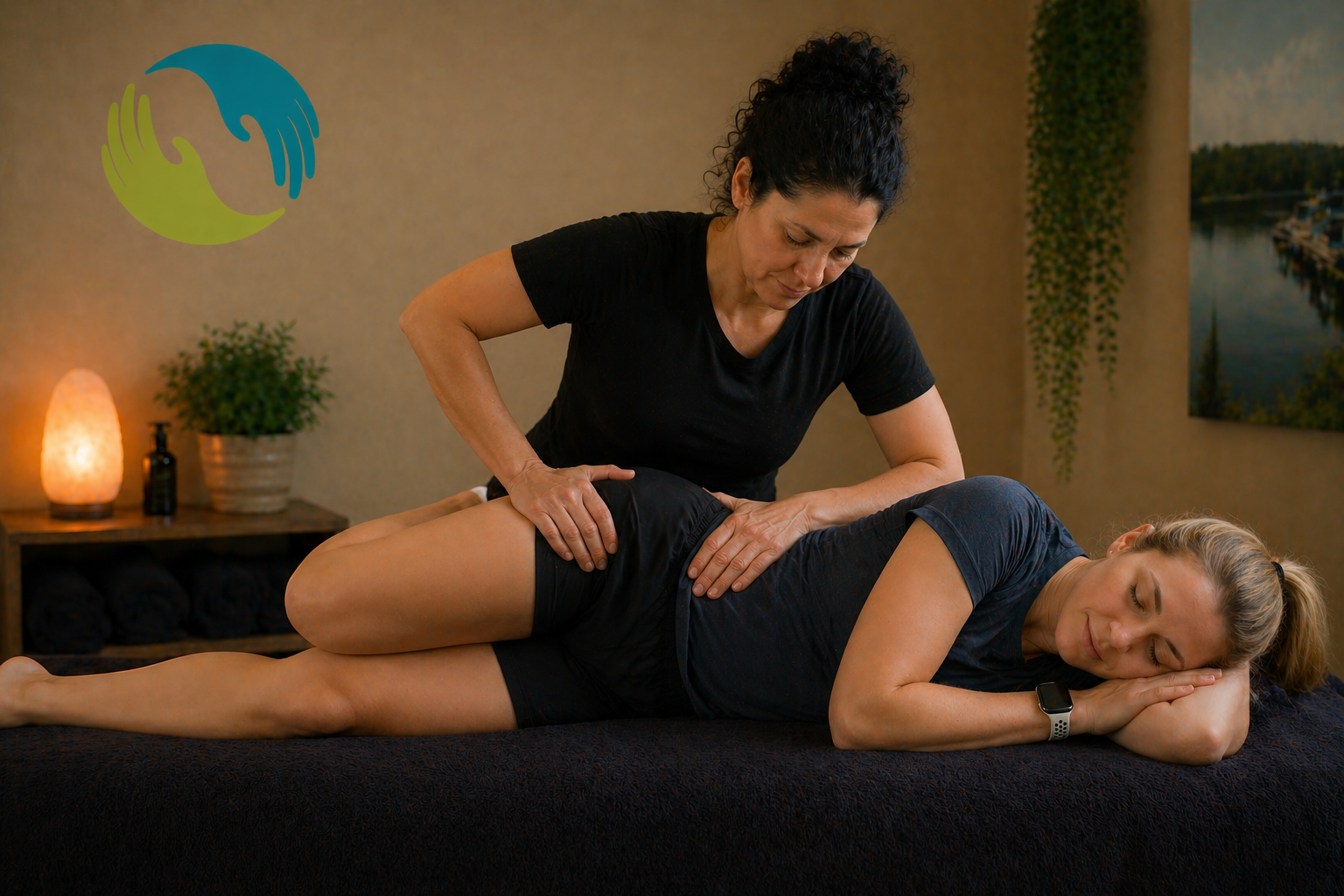
The 5 evidence-supported benefits of athlete massage
1. Accelerated muscle recovery
Intense training produces metabolic waste accumulation in muscle tissue: lactic acid, cytokines, and other byproducts of anaerobic metabolism that need to be cleared before the tissue can return to full function. Massage accelerates this clearance by increasing local blood and lymphatic flow through the affected muscles. According to Physiopedia, massage after high-intensity training reduces recovery time markers by an average of 20-30% compared to passive rest alone, with the largest effects observed in endurance athletes and in resistance training populations.
2. Reduced delayed onset muscle soreness
Delayed onset muscle soreness (DOMS) peaks at 24-72 hours after intensive training and is driven by the inflammatory response to micro-damage in the muscle fibres. Massage reduces DOMS through two mechanisms: increasing circulation to clear the inflammatory mediators from the tissue, and activating the parasympathetic nervous system which reduces the neurogenic component of post-exercise pain amplification. Athletes who receive massage in the 2-24 hour window after intensive training consistently report significantly lower DOMS scores than those who rest passively.
3. Improved range of motion
Repeated high-load training produces fascial thickening and shortening in the primary movers. This gradual loss of range of motion reduces movement efficiency and increases injury risk. Regular massage maintains fascial mobility by preventing the cross-linking and adhesion formation that repeated loading without manual intervention produces. Deep tissue massage for athletes specifically targeting the primary movers for each sport produces measurable improvements in range of motion that passive stretching alone cannot achieve.
4. Improved sleep quality on training nights
Research published in the Journal of Medical Internet Research confirmed that massage therapy produces significant improvements in sleep latency and sleep quality, with particularly strong effects in people who are physically active and experiencing training-related sympathetic activation (JMIR, 2024: https://www.jmir.org). Athletes who train in the evening are particularly susceptible to sleep disruption from elevated sympathetic tone post-training. Massage in the recovery period activates parasympathetic tone and significantly improves sleep quality on training nights.
5. Reduced soft tissue injury risk
Trigger points in the primary movers of any sport represent a significant injury risk: the affected muscle fibres are generating a continuous contractile signal that reduces their reserve capacity. When additional loading is applied to a muscle with established trigger points, the threshold for acute strain or tear is significantly lower. Regular massage that maintains low trigger point loads in the primary movers of each athlete's sport is one of the most effective injury prevention strategies available.
Timing: when to get massage for maximum benefit
Pre-competition or pre-event (24-48 hours before)
Lighter, activating massage that increases circulation without producing the tissue tenderness that deep work can cause. Focus is on maintaining range of motion and activating the neuromuscular pathways for the event. Heavy deep tissue work in the 24 hours before competition is not recommended.
Post-training recovery (2-24 hours after training)
The optimal window for recovery-focused massage. Deep tissue work on the primary movers and acupressure on the trigger points that training has loaded. This window produces the strongest effect on DOMS reduction and recovery acceleration.
Maintenance (weekly or fortnightly between training blocks)
The most impactful use of massage for injury prevention. Regular maintenance sessions that clear the trigger point load accumulated from the training week prevent the gradual deterioration in muscle resilience that builds across a season without manual intervention. Athlete recovery massage as a maintenance strategy is more cost-effective than acute treatment after injury.
What to expect from a session at Easy Cozy
Athlete sessions begin with a brief assessment of the sport, the training load, and the specific structures most involved. Treatment is then directed at the muscles most loaded by the athlete's activity: for runners, the hip flexors, IT band, piriformis and plantar fascia; for cyclists, the hip flexors, lumbar erectors and piriformis; for swimmers, the rotator cuff, thoracic paraspinals and pectoral complex; for strength athletes, the lumbar erectors, QL, hip flexors and thoracic paraspinals.
Acupressure is integrated for the deep iliacus, piriformis and specific trigger point locations that deep tissue massage cannot reach with sufficient depth and specificity. This combination produces a more complete recovery stimulus than either approach alone.
Sports massage for specific sports in Nanaimo
Nanaimo has a strong outdoor and recreational sport community: trail running, cycling, swimming, team sports, CrossFit and strength training. Each sport creates a specific pattern of muscular loading that responds to targeted treatment:
Runners: hip flexor shortening, IT band tightness, plantar fascia loading and piriformis tightness from the repetitive unilateral loading of running.
Cyclists: hip flexor shortening from sustained hip flexion in the riding position, lumbar erector fatigue from sustained forward trunk flexion.
Team sport athletes (football, rugby, soccer): acute soft tissue loading from contact and change of direction, IT band and hip flexor tightness from sprint-based training.
CrossFit and strength athletes: thoracic and lumbar paraspinal loading from barbell work, hip flexor shortening from squat-pattern repetition.
Swimmers: rotator cuff overuse, thoracic paraspinal loading and pectoral shortening from the high-volume shoulder patterns of freestyle and butterfly.
Athlete recovery massage at Easy Cozy Nanaimo
At Easy Cozy in Nanaimo, athlete recovery sessions are structured around the specific demands of each person's sport and training load. No referral needed, no waitlist, and session times are available across the week to fit around training schedules.
According to Health Canada's published guidance on sports-related musculoskeletal care, massage therapy is a safe and evidence-supported component of athletic recovery and injury prevention programs, with benefits identified across both competitive and recreational athletic populations (Government of Canada, 2024: https://www.canada.ca/en/health-canada.html). Train harder; recover smarter. [related reading: massage and sleep quality]
Train harder and recover smarter. Book a recovery session at Easy Cozy Nanaimo today. No referral, no waitlist.
Book Now: https://easycozy.ca/booking
Frequently asked questions
Does massage help athletic recovery?
Yes, through five specific mechanisms: accelerated metabolic waste clearance, reduced delayed onset muscle soreness (DOMS), improved range of motion through fascial maintenance, better sleep quality on training nights through parasympathetic activation, and reduced injury risk from maintaining low trigger point loads in the primary movers. The evidence consistently shows faster recovery times and lower DOMS scores for athletes who receive regular massage compared to passive rest alone.
How often should athletes get massage?
For athletes in regular training: weekly or fortnightly maintenance sessions during training blocks maintain the injury prevention and performance benefits most effectively. Pre-competition sessions are most appropriate 24-48 hours before events (lighter work). Post-training recovery sessions are most effective 2-24 hours after intensive training. During reduced training or off-season periods, monthly maintenance is typically sufficient.
What is the best type of massage for athletes?
Deep tissue massage on the primary movers combined with acupressure at the specific trigger points and fascial restriction points most loaded by the athlete's sport. Deep tissue massage addresses the broad myofascial loading pattern and improves circulation. Acupressure addresses the specific deep trigger points that standard massage cannot reach with sufficient depth. The combination produces stronger recovery and range of motion outcomes than either technique alone.
When should I get a massage after training?
The 2-24 hour window after intensive training is the optimal time for recovery massage. This window allows the acute inflammatory response to begin naturally while still allowing massage to accelerate metabolic waste clearance and reduce the DOMS peak. Massage within 2 hours of training can interrupt the natural recovery initiation process. Massage beyond 48 hours after training misses the optimal DOMS-reduction window but still provides value for range of motion and trigger point maintenance.
Final Suggestion
If you’re looking for massage therapy in Nanaimo that helps you feel relaxed, refreshed, and back to your best, Easy Cozy Wellness is here to help.
We focus on real results, not just temporary relief. Whether you’re dealing with daily tension, chronic discomfort, or simply need time to unwind, our treatments are designed to support your body and your overall well-being.
We regularly help clients with:
• Back pain
• Neck pain
• Shoulder pain
• Lower back pain
• Lumbar pain
• Headaches and migraines
• Sciatic pain (sciatica)
• Hip pain
• Knee pain
• Elbow pain (tennis elbow, golfer’s elbow)
• Leg pain and muscle tightness
• Foot pain and plantar fasciitis
• Hand and wrist pain (including carpal tunnel symptoms)
• Joint pain and inflammation
• Muscle soreness and post-workout recovery
• Chronic pain conditions
• Nerve pain and tension
• Upper back and mid-back pain
• Glute pain and piriformis syndrome
• Calf tightness and strain
• Shin splints
• Ankle pain and mobility issues
• Postural pain from sitting or desk work
• Repetitive strain injuries (RSI)
• Stress, tension, and fatigue
Our services include:
• Relaxation massage
• Deep tissue massage
• Therapeutic massage
• Pain relief massage
• Stress relief treatments
• Wellness and recovery sessions
• Preventative body care
At Easy Cozy Wellness, the goal is simple. Help your body feel better, move better, and recover faster.
If you’ve been searching for:
massage therapy Nanaimo
best massage Nanaimo
affordable massage Nanaimo
deep tissue massage Nanaimo
relaxation massage Nanaimo
pain relief massage Nanaimo
wellness clinic Nanaimo
You’re in the right place.
Give us a call at 778-561-0208 and book your next wellness appointment today.
Or visithttps://easycozy.ca/to learn more about our services, see current offers, and review our satisfaction guarantee.
We’re proud to offer a more affordable option compared to many local providers, without compromising on quality or results.
Once you experience the difference, you’ll understand why so many people choose Easy Cozy Wellness for ongoing care.
You can schedule your massage appointment here:
Relaxation is not a luxury — it’s an essential part of staying healthy and energized.
Your body will thank you. Talk soon.

