Can Massage Improve Sleep Quality? 5 Research-Backed Reasons It Does
Can Massage Improve Sleep Quality? 5 Research-Backed Reasons It Does
Massage can improve sleep quality, and the evidence for this is stronger than most people realise. The research on massage and sleep identifies five specific biological mechanisms through which regular massage treatment produces measurable improvements in sleep onset, duration, and quality, particularly for people whose sleep problems are linked to stress, anxiety, or chronic muscle tension.
New Blog Post
Can Massage Improve Sleep Quality? 5 Research-Backed Reasons It Does
The 5 mechanisms: how massage improves sleep quality
2. Serotonin and melatonin upregulation
3. Parasympathetic nervous system activation
5. Anxiety and rumination reduction
What the research actually shows
Who benefits most from massage for sleep
How to use massage most effectively for sleep improvement
Can massage really improve sleep quality?
How many massage sessions does it take to improve sleep?
The 5 mechanisms: how massage improves sleep quality
1. Cortisol reduction
Cortisol, the stress hormone, is one of the primary inhibitors of sleep onset. Elevated cortisol keeps the nervous system in an alert state that is incompatible with the transition into sleep. Research published in the Journal of Medical Internet Research (JMIR) found that massage therapy produces significant reductions in salivary cortisol, with effects measurable immediately post-session and sustained for 24-48 hours in regular recipients (JMIR, 2024: https://www.jmir.org). Reduced cortisol after a massage session lowers the physiological barrier to sleep onset.
2. Serotonin and melatonin upregulation
Massage stimulates the release of serotonin, the precursor to melatonin, the hormone that regulates the sleep-wake cycle. By increasing serotonin levels, massage indirectly increases melatonin production, which improves both sleep onset and sleep quality. This is one of the most direct biochemical pathways connecting massage to sleep improvement.
3. Parasympathetic nervous system activation
Slow, sustained massage pressure activates the parasympathetic nervous system, the rest-and-digest response that is the physiological prerequisite for deep sleep. Many people with massage therapy and insomnia connections find that their sleep latency, the time it takes to fall asleep, reduces significantly following regular massage treatment, because the parasympathetic activation achieved in session carries over into the hours that follow.
4. Muscle tension reduction
Physical muscle tension is one of the most common barriers to sleep quality. People carrying significant tension in the neck, shoulders, lower back or hips often cannot fully relax even in a horizontal position. Trigger points and fascial restrictions keep the muscles in a partially contracted state, generating low-level discomfort that prevents the deep relaxation required for restorative sleep. Targeted massage releases this tension, allowing the body to achieve the physical relaxation that deep sleep requires.
5. Anxiety and rumination reduction
Chronic anxiety and mental rumination are the primary causes of sleep-onset insomnia, the inability to fall asleep despite physical tiredness. Massage reduces anxiety through the cortisol, serotonin and parasympathetic pathways described above. The Canadian Mental Health Association notes that anxiety-related sleep disruption responds to interventions that simultaneously reduce physiological arousal and cognitive activation, which massage addresses through its combined effect on the nervous system and muscle tension (CMHA, 2024: https://cmha.ca/).
What the research actually shows
The effect is cumulative: single sessions produce measurable but modest sleep improvements, while a course of regular sessions, typically six to eight over four to eight weeks, produces sustained improvements that persist beyond the treatment period. This is consistent with the serotonin and cortisol mechanisms, which take time to recalibrate through regular therapeutic input. For does massage help you sleep as an ongoing strategy, regular monthly maintenance sessions maintain the effect after an initial course.
Who benefits most from massage for sleep
People whose sleep problems are stress or anxiety driven, the cortisol and parasympathetic pathways are particularly active in this population.
People with chronic muscle tension in the neck, upper back or lower back, physical tension that prevents physical relaxation at night.
People in high-demand occupations or life circumstances, caregivers, parents, people in demanding jobs, where the physiological stress load is consistently elevated.
People who have tried standard sleep hygiene approaches without full resolution.
People with chronic pain conditions where pain is disrupting sleep continuity.
Massage is less effective as a primary intervention for sleep problems that are primarily circadian (shift workers, jet lag) or sleep architecture disorders (sleep apnoea, REM behaviour disorder). For these, medical assessment is the appropriate first step. For massage for sleep disorders linked to stress, tension and anxiety, it is one of the most evidence-supported non-pharmacological options available.
How to use massage most effectively for sleep improvement
Timing: a session 2-4 hours before bed produces the strongest sleep benefit, cortisol is reduced, parasympathetic tone is elevated, and the body has transitioned from the active post-massage state into readiness for sleep.
Frequency: for significant sleep improvement, an initial course of 4-6 sessions over 4-6 weeks produces the most reliable effect. Monthly maintenance sessions sustain it.
Focus: sessions targeting the upper trapezius, neck, and lower back, the areas where stress and tension most commonly accumulate, produce stronger sleep benefits than general relaxation massage.
Combination: massage combined with consistent sleep hygiene (fixed wake time, dark and cool room, no screens for 1 hour before bed) produces significantly better results than either approach alone.
For massage before bed benefits and the science behind optimal timing, the mechanism is straightforward: parasympathetic activation achieved during a session peaks approximately 2-3 hours post-session, which is the window where it most effectively supports sleep onset.
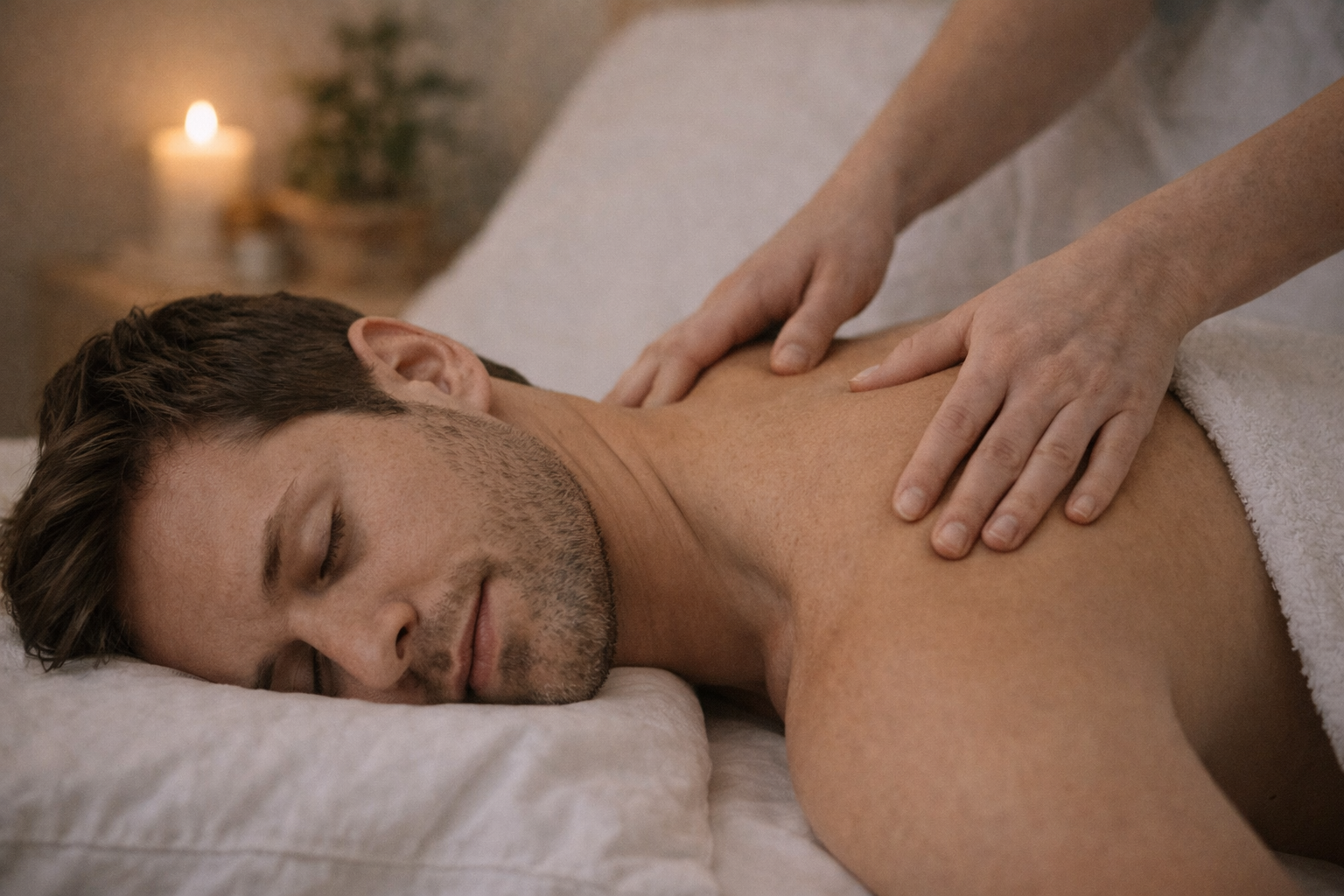
Massage for sleep in Nanaimo
Sleep disruption linked to stress and body tension is one of the most common secondary complaints we treat at Easy Cozy in Nanaimo, alongside the primary presenting condition of back pain, neck pain, or stress tension. The connection between physical tension and sleep quality means that treating the tension often produces sleep improvements that clients did not initially expect.
Sessions targeting the cortisol, serotonin and parasympathetic pathways most relevant to sleep benefit from the combination of deep tissue massage and acupressure that Easy Cozy specialises in. According to Health Canada's published guidance on non-pharmacological sleep interventions, massage therapy is identified as an evidence-supported adjunct treatment for stress-related sleep disturbance, with a safety profile that makes it appropriate for most adults without contraindications (Government of Canada, 2024: https://www.canada.ca/en/health-canada.html). No referral needed.
Now that you understand the research, the next step is a session designed to address the stress and tension patterns affecting your sleep. Book at Easy Cozy today.
Book Now: https://easycozy.ca/booking
Frequently asked questions
Can massage really improve sleep quality?
Yes, through five specific mechanisms: cortisol reduction, serotonin and melatonin upregulation, parasympathetic nervous system activation, muscle tension release, and anxiety reduction. Multiple systematic reviews confirm that massage therapy produces measurable improvements in sleep onset, total sleep time, night-time waking, and subjective sleep quality. Effects are strongest in people with stress-related sleep problems.
How many massage sessions does it take to improve sleep?
Single sessions produce measurable but modest sleep improvements for most people. A course of four to six sessions over four to six weeks produces significant and sustained improvement in sleep quality. Monthly maintenance sessions sustain the benefit after the initial course. The improvement tends to be cumulative, reflecting the gradual recalibration of cortisol and serotonin levels through regular treatment.
What type of massage is best for sleep?
For sleep improvement, the most effective massage focuses on the areas where stress and tension accumulate most: the upper trapezius, neck and lower back. Slower, sustained pressure targeting trigger points and fascial restrictions produces stronger sleep benefits than light, rapid strokes. Acupressure on the relevant nervous system points further enhances the parasympathetic activation that supports sleep onset.
Is massage or medication better for sleep problems?
For stress and tension-driven sleep problems, massage addresses the physiological causes rather than suppressing the symptom. Sleep medications can help with acute insomnia but do not resolve the underlying cortisol elevation, muscle tension, or anxiety that is preventing sleep. Massage is most effective as a primary or complementary approach. For sleep disorders with a medical origin, sleep apnoea, circadian disruption, medical assessment is the appropriate first step.
Final Suggestion
If you’re looking for massage therapy in Nanaimo that helps you feel relaxed, refreshed, and back to your best, Easy Cozy Wellness is here to help.
We focus on real results, not just temporary relief. Whether you’re dealing with daily tension, chronic discomfort, or simply need time to unwind, our treatments are designed to support your body and your overall well-being.
We regularly help clients with:
Sciatic pain (sciatica)
Hip pain
Knee pain
Elbow pain (tennis elbow, golfer’s elbow)
Leg pain and muscle tightness
Foot pain and plantar fasciitis
Hand and wrist pain (including carpal tunnel symptoms)
Joint pain and inflammation
Muscle soreness and post-workout recovery
Chronic pain conditions
Nerve pain and tension
Upper back and mid-back pain
Glute pain and piriformis syndrome
Calf tightness and strain
Shin splints
Ankle pain and mobility issues
Postural pain from sitting or desk work
Repetitive strain injuries (RSI)
Stress, tension, and fatigue
Our services include:
Relaxation massage
Deep tissue massage
Therapeutic massage
Pain relief massage
Stress relief treatments
Wellness and recovery sessions
Preventative body care
At Easy Cozy Wellness, the goal is simple. Help your body feel better, move better, and recover faster.
If you’ve been searching for:
massage therapy Nanaimo
best massage Nanaimo
affordable massage Nanaimo
deep tissue massage Nanaimo
relaxation massage Nanaimo
pain relief massage Nanaimo
wellness clinic Nanaimo
You’re in the right place.
Give us a call at 778-561-0208 and book your next wellness appointment today.
Or visit https://easycozy.ca/ to learn more about our services, see current offers, and review our satisfaction guarantee.
We’re proud to offer a more affordable option compared to many local providers, without compromising on quality or results.
Once you experience the difference, you’ll understand why so many people choose Easy Cozy Wellness for ongoing care.
You can schedule your massage appointment here:
Relaxation is not a luxury — it’s an essential part of staying healthy and energized.
Your body will thank you. Talk soon.

