How Acupressure Relieves Back Pain: 5 Proven Mechanisms
How Acupressure Relieves Back Pain: 5 Proven Mechanisms
How acupressure relieves back pain is now understood through five distinct physiological mechanisms — and what distinguishes acupressure from standard massage is that it addresses both the tissue-level tension and the nervous system component that drives and amplifies back pain simultaneously. This dual action is the reason acupressure often reaches the pain that massage alone has not fully resolved.
This post explains each mechanism, the specific acupressure points most relevant to lower back pain, and why the combination of acupressure and deep tissue massage at Easy Cozy produces results that either approach alone does not consistently achieve.
Table of contents
1. What acupressure is and how it differs from massage
2. The 5 mechanisms through which acupressure relieves back pain
3. The key acupressure points for lower back pain
4. What the evidence shows
5. Acupressure vs massage for back pain: why both together
6. Acupressure for back pain at Easy Cozy Nanaimo
7. Frequently asked questions
What acupressure is and how it differs from massage
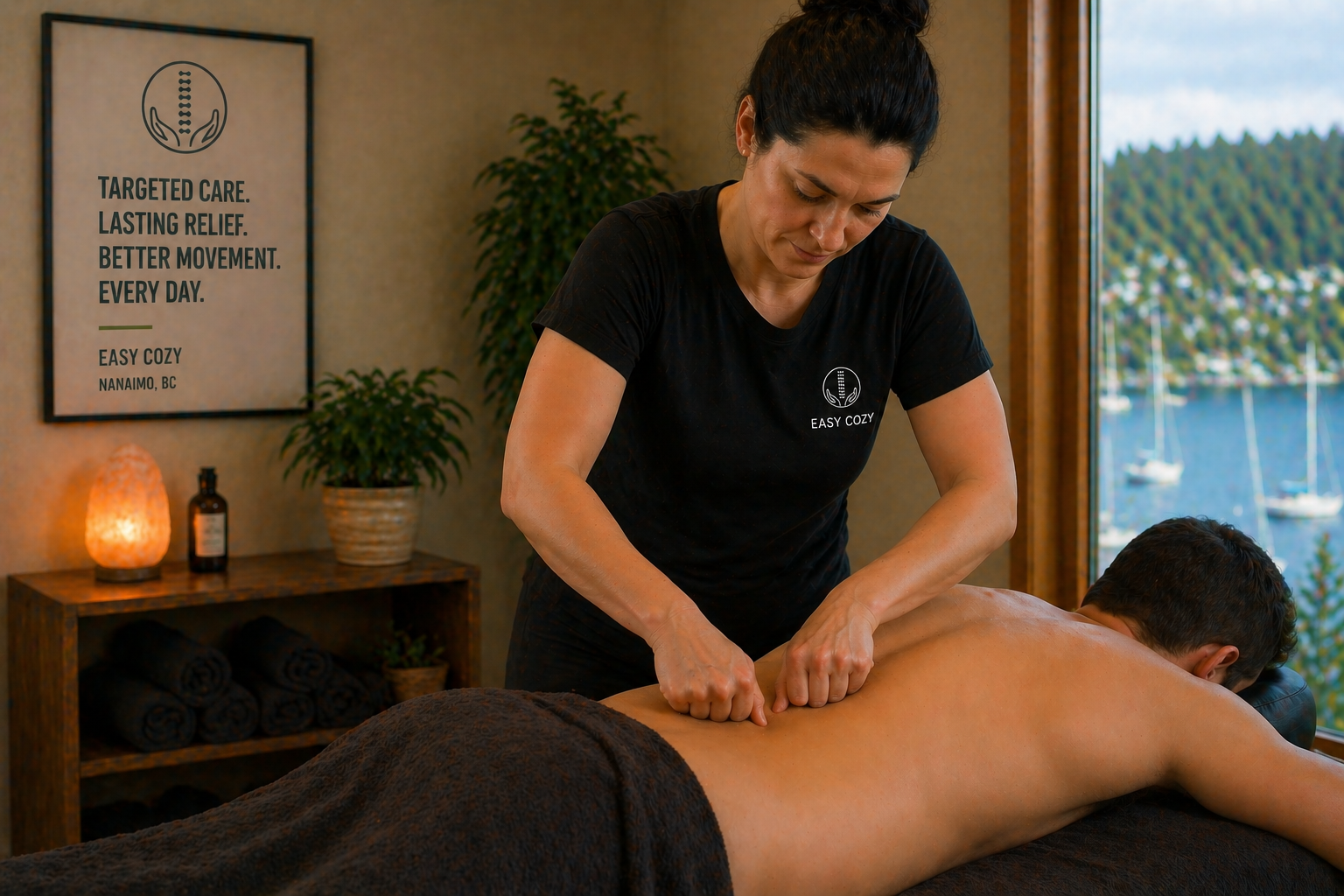
Acupressure applies sustained, precise pressure to specific anatomical points along the body's myofascial and neural pathways. Where massage uses movement — effleurage, petrissage, cross-fibre friction — across a broad area of tissue, acupressure uses static, directed pressure held at a specific point for 60-120 seconds or more. This sustained pressure at a specific location produces a different quality of tissue response and a different nervous system effect from the sweeping pressure of standard massage.
The points used in acupressure for back pain correspond to locations that are both anatomically significant — along the paths of major nerves, at the attachments of key muscles, at the entrances of fascia compartments — and neurologically significant, in that sustained stimulation at these points produces measurable changes in pain processing, muscle tone, and autonomic nervous system activity. This is not placebo: the mechanisms are understood and measurable.
The 5 mechanisms through which acupressure relieves back pain
1. Trigger point deactivation through sustained ischaemic compression
Sustained pressure applied directly to a trigger point — the tight, hypersensitive muscle knot that is the primary driver of most non-specific back pain — creates ischaemic compression: a brief, controlled reduction in blood flow through the point. When the pressure is released, the reactive hyperaemia (rush of blood back into the area) clears the accumulated metabolic waste products that sustain the trigger point. The trigger point deactivates, the local muscle tension releases, and the pain it was generating stops. Acupressure for back pain relief through this mechanism is particularly effective for deep iliacus, QL and piriformis trigger points that standard massage pressure cannot reach.
2. Endorphin and enkephalin release
Sustained acupressure stimulation triggers the release of endorphins and enkephalins — the body's endogenous opioid peptides — at the spinal cord level. These neuropeptides reduce pain signal transmission, producing both local and systemic pain relief that outlasts the session. This is the mechanism responsible for the pain-free sensation many people notice in the hours after acupressure treatment even in areas that were not directly treated.
3. Gate control at the spinal cord
Acupressure stimulates large-diameter sensory nerve fibres (A-beta fibres) at the treatment point. These fibres, when active, inhibit the transmission of pain signals from the smaller C-fibres and A-delta fibres that carry the back pain signal to the brain. This is the gate control mechanism: sustained acupressure pressure essentially closes the gate on pain transmission at the spinal level while the treatment is active, and the gate remains partially closed for hours after treatment through neurochemical changes.
4. Parasympathetic nervous system activation
Specific acupressure points — particularly those along the Governing Vessel, Bladder Meridian and sacral points relevant to lower back pain — directly stimulate the parasympathetic nervous system. This reduces the sympathetic activation that maintains muscle guarding and pain sensitisation. For back pain with a significant stress component — where the nervous system is maintaining elevated muscle tone as part of a chronic stress pattern — this mechanism is critical and is the component that distinguishes acupressure from standard massage in its back pain effect.
5. Myofascial release through sustained pressure
Sustained pressure at specific points along fascial lines produces a viscoelastic response in the fascia: the tissue gradually softens and lengthens under maintained pressure. This is different from the mechanical release of trigger point compression — it is a direct structural change in the fascial tissue that allows the lumbar spine and surrounding structures to adopt a more neutral position. Does acupressure work for back pain through this mechanism: yes, measurably, particularly for the tight iliotibial band, thoracolumbar fascia and hip flexor complex.
The key acupressure points for lower back pain
The points most consistently effective for lower back pain in clinical practice are:
BL 23 and BL 25 (Bladder 23 and 25): located 1.5 inches lateral to the spinous processes of L2 and L4. These are the primary lumbar points for lower back pain, positioned directly over the lumbar erector and QL attachment areas.
BL 40 (Bladder 40): located at the midpoint of the popliteal crease behind the knee. Despite its distant location, BL 40 is one of the most effective points for lower back pain through the gate control and endorphin mechanisms. It is particularly effective for acute back pain.
GB 30 (Gallbladder 30): located in the gluteal region at the piriformis attachment. This point directly addresses the piriformis trigger points that are a significant driver of lower back and sciatic-referral pain patterns.
SP 6 (Spleen 6): located 3 inches above the medial malleolus on the tibia. Effective for stress-related back pain through the parasympathetic activation mechanism.
GV 4 (Governing Vessel 4): located between L2 and L3. Direct application at this point on the posterior midline addresses the deep paraspinal tension and produces the strongest autonomic response of any lumbar acupressure point.
What the evidence shows
According to Physiopedia, multiple randomised controlled trials have demonstrated that acupressure produces significantly greater reductions in lower back pain intensity than sham acupressure, standard massage alone, or usual care in both acute and chronic presentations. The most consistent finding is that combining acupressure with massage produces stronger outcomes than either alone.
The NHS acknowledges acupressure and acupuncture as evidence-supported complementary interventions for chronic lower back pain, noting that the mechanisms are physiologically plausible and the evidence for clinical benefit is sufficient to recommend consideration for people whose back pain has not responded adequately to other first-line treatments (NHS, 2024: https://www.nhs.uk/conditions/back-pain/).
Acupressure vs massage for back pain: why both together
For acupressure vs massage for back pain, the question is not which is better — it is that they address different dimensions of the same problem. Massage addresses the broad myofascial loading pattern: releasing the larger muscle groups, increasing circulation, reducing overall tension. Acupressure addresses the specific trigger points and neural pathways that massage pressure cannot reach: the deep iliacus, the GV4 paraspinal point, the piriformis at GB 30.
The combination produces results that neither alone consistently achieves: the massage prepares the tissue for the more specific acupressure work; the acupressure deactivates the specific trigger points and neural pathways that the massage has loosened but not fully released. This is the treatment model at Easy Cozy and the reason our back pain results are consistently more complete than standard massage alone. [related reading: why your back pain keep coming back]
Acupressure for back pain at Easy Cozy Nanaimo
At Easy Cozy in Nanaimo, acupressure is integrated into back pain treatment as the specific tool for the structures that require it: the deep hip flexors, the piriformis, the QL attachment, and the paraspinal points where standard massage pressure is insufficient. Every back pain session combines deep tissue massage on the broader muscle groups with targeted acupressure on the specific points identified as most relevant to the individual's pattern.
Many clients who have had standard massage for their back pain without the expected results find that the acupressure component produces a qualitatively different and more complete release — particularly the piriformis and iliacus points that are anatomically deep and require the sustained, directed pressure that acupressure delivers. According to Health Canada's evidence summary on complementary pain interventions, acupressure is identified as a safe, non-invasive, evidence-supported intervention for lower back pain appropriate for most adults without contraindications (Government of Canada, 2024: https://www.canada.ca/en/health-canada.html). No referral needed. [related reading: lower back pain fast relief]
Try acupressure at Easy Cozy — experience the difference between standard massage and targeted acupressure for your back pain. Book a session today. No referral, no waitlist.
Book Now: https://easycozy.ca/booking
Frequently asked questions
Does acupressure really work for back pain?
Yes — through five distinct mechanisms: trigger point deactivation via ischaemic compression, endorphin and enkephalin release, gate control inhibition of pain signals at the spinal cord, parasympathetic nervous system activation, and myofascial release through sustained fascial pressure. Multiple randomised controlled trials have demonstrated significantly greater pain reduction from acupressure compared to sham treatment, with the strongest results when combined with massage.
Which acupressure points are best for lower back pain?
The most clinically effective points for lower back pain are BL 23 and BL 25 (1.5 inches lateral to L2 and L4 — over the lumbar erectors and QL), BL 40 (behind the knee — activates gate control for acute back pain), GB 30 (in the gluteal region at the piriformis attachment), GV 4 (between L2 and L3 on the posterior midline), and SP 6 (3 inches above the medial malleolus for stress-related back pain).
How long does acupressure take to work for back pain?
Acupressure produces immediate physiological changes during the session: trigger points begin deactivating within 60-90 seconds of sustained compression, and the endorphin and gate control effects are active during the treatment. Most people notice reduced pain and improved movement within the session itself. The full anti-inflammatory and nervous system effects peak at 24-48 hours post-session, similar to the pattern for deep tissue massage.
Is acupressure better than massage for back pain?
Acupressure and massage are not competing alternatives — they address different aspects of back pain most effectively. Massage addresses the broad myofascial loading pattern and increases circulation. Acupressure addresses specific deep trigger points and neural pathways that massage cannot reach with sufficient depth and specificity. The combination of both in a single session produces consistently stronger results than either alone, which is the model used at Easy Cozy.
Final Suggestion
If you’re looking for massage therapy in Nanaimo that helps you feel relaxed, refreshed, and back to your best, Easy Cozy Wellness is here to help.
We focus on real results, not just temporary relief. Whether you’re dealing with daily tension, chronic discomfort, or simply need time to unwind, our treatments are designed to support your body and your overall well-being.
We regularly help clients with:
• Back pain
• Neck pain
• Shoulder pain
• Lower back pain
• Lumbar pain
• Headaches and migraines
• Sciatic pain (sciatica)
• Hip pain
• Knee pain
• Elbow pain (tennis elbow, golfer’s elbow)
• Leg pain and muscle tightness
• Foot pain and plantar fasciitis
• Hand and wrist pain (including carpal tunnel symptoms)
• Joint pain and inflammation
• Muscle soreness and post-workout recovery
• Chronic pain conditions
• Nerve pain and tension
• Upper back and mid-back pain
• Glute pain and piriformis syndrome
• Calf tightness and strain
• Shin splints
• Ankle pain and mobility issues
• Postural pain from sitting or desk work
• Repetitive strain injuries (RSI)
• Stress, tension, and fatigue
Our services include:
• Relaxation massage
• Deep tissue massage
• Therapeutic massage
• Pain relief massage
• Stress relief treatments
• Wellness and recovery sessions
• Preventative body care
At Easy Cozy Wellness, the goal is simple. Help your body feel better, move better, and recover faster.
If you’ve been searching for:
massage therapy Nanaimo
best massage Nanaimo
affordable massage Nanaimo
deep tissue massage Nanaimo
relaxation massage Nanaimo
pain relief massage Nanaimo
wellness clinic Nanaimo
You’re in the right place.
Give us a call at 778-561-0208 and book your next wellness appointment today.
Or visithttps://easycozy.ca/to learn more about our services, see current offers, and review our satisfaction guarantee.
We’re proud to offer a more affordable option compared to many local providers, without compromising on quality or results.
Once you experience the difference, you’ll understand why so many people choose Easy Cozy Wellness for ongoing care.
You can schedule your massage appointment here:
Relaxation is not a luxury — it’s an essential part of staying healthy and energized.
Your body will thank you. Talk soon.

