Daily Habits Causing Neck and Shoulder Tension: 7 Culprits
Daily Habits Causing Neck and Shoulder Tension: 7 Proven Culprits
Daily habits causing neck and shoulder tension are often invisible until the pain has become chronic — because the loading happens gradually, over weeks and months, through patterns so familiar they feel normal. The seven habits below are responsible for the majority of non-traumatic neck and shoulder pain in adults, and most people who have persistent tension are doing at least four of them simultaneously.
The good news is that identifying and changing a habit is the single fastest long-term intervention for neck and shoulder tension. This post explains each habit, why it creates the tension it does, and exactly what to change.
Table of contents
1. The 7 daily habits causing neck and shoulder tension
2. Why habits create permanent-feeling tension
3. How to change the habits that are causing your pain
4. When habit change is not enough
5. Neck and shoulder tension treatment in Nanaimo
6. Frequently asked questions
The 7 daily habits causing neck and shoulder tension
The habits below are identified based on their biomechanical impact on the cervical and upper thoracic musculature. According to Physiopedia, modifiable behavioural factors — particularly habitual posture and device use patterns — are among the strongest predictors of neck pain development and chronicity in adults.
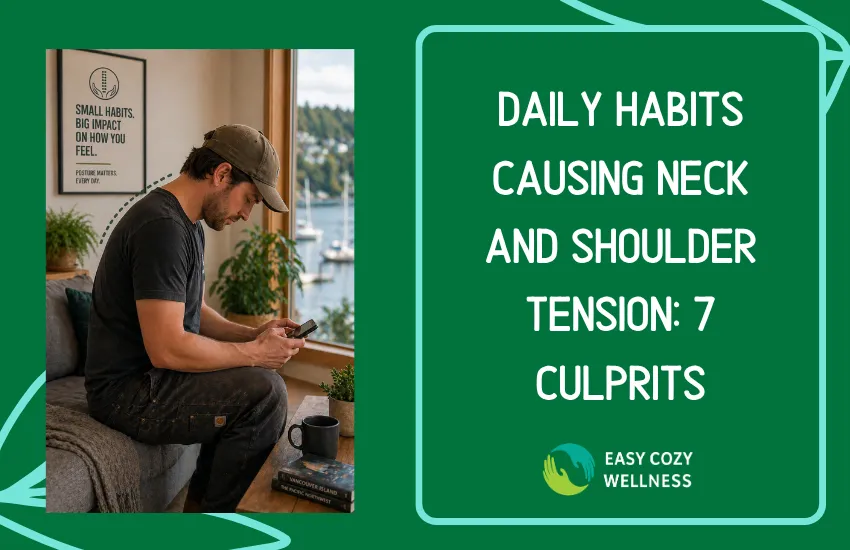
1. Looking down at a phone (text neck)
Every 2.5 centimetres the head tilts forward adds approximately 4.5kg of effective load on the cervical spine. Reading a phone held at chest or lap height — the typical position — places the head in 45-60 degrees of flexion, creating a sustained load equivalent to carrying a weight of 20-27kg on the neck. Phone habits causing neck pain are responsible for the fastest-growing category of cervical muscle overload in adults and adolescents.
2. Sleeping on the stomach
Stomach sleeping requires the neck to be rotated to one side for the entire duration of sleep. This sustained rotation position creates unilateral SCM and suboccipital loading for 6-8 hours nightly. Over months, this produces consistently one-sided neck tightness and trigger points on the rotation side. It is one of the most impactful habits for neck tension because of the cumulative duration.
3. Cradling the phone between ear and shoulder
Even brief phone-to-shoulder cradling creates extreme lateral neck flexion and shoulder elevation on the affected side. The levator scapulae is placed in maximum shortening while simultaneously supporting the weight of the head at an extreme angle. People who do this several times daily accumulate the equivalent of hours of extreme neck loading weekly.
4. Carrying a bag on one shoulder
A shoulder bag on one side creates a persistent downward pull on the trapezius on the bag-carrying side. The upper trapezius elevates the shoulder against this pull continuously. Over months, bad habits causing shoulder tension like this one create highly predictable trigger points on the bag-carrying side and a habitual asymmetric shoulder posture that persists even when the bag is not being carried.
5. Sitting with legs crossed
Leg crossing creates a pelvic tilt that the spinal musculature must compensate for. The compensatory response involves slight lateral flexion of the lumbar spine, rotation of the thoracic spine, and cervical repositioning. Sustained leg crossing for hours daily accumulates rotational loading through the entire spinal chain — contributing to both lower back and neck tension through the same pattern.
6. Tensing the jaw and clenching the teeth
Jaw clenching — most commonly associated with stress, concentration, or sleep — activates the masseter and temporal muscles and creates a tensing of the entire upper cervical chain through the trigeminal-cervical connection. Neck and shoulder tension from daily stress habits including jaw clenching contributes to suboccipital tension, headaches and neck stiffness in a way that is not obvious until the jaw is specifically assessed. Many people carry significant masseter tension without being aware of it.
7. Sleeping with an arm raised or under a pillow
Sleeping with the arm raised above the head or tucked under the pillow creates sustained shoulder elevation and external rotation that loads the rotator cuff and the levator scapulae on that side. Many people with recurring shoulder or neck pain on the side they sleep on have this habit as a contributing factor. It is easily confirmed by checking whether the same-side shoulder and neck is consistently tighter on waking than on going to bed. [related reading: shoulder pain from desk work]
Why habits create permanent-feeling tension
Habitual loading creates structural changes in muscle tissue over time. Muscles that are consistently held in shortened positions develop sarcomeres — the contractile units — at shorter resting lengths. Muscles that are consistently placed under sustained eccentric load develop trigger points. After months or years of the same habit, the resulting tension is no longer just the effect of the current habit — it is embedded in the tissue.
This is why stopping a habit does not immediately resolve the tension it created. The structural changes in the tissue — the shortened sarcomeres, the established trigger points — remain after the habit changes and require direct treatment to reverse. How to stop habits causing neck tension begins with changing the habit but requires hands-on treatment to clear the tissue damage that has already accumulated.
How to change the habits that are causing your pain
Text neck: hold your phone at eye level when reading. A phone stand or prop on a table is the most reliable way to make this habitual.
Stomach sleeping: place a body pillow in front of you and wedge yourself onto your side. It takes 2-3 weeks for a new sleep position to become habitual.
Phone-to-shoulder cradling: use headphones or speakerphone for any call longer than 60 seconds. This is a complete elimination, not a reduction.
One-shoulder bag: switch to a backpack or alternate shoulders daily. A bag strap with a pad significantly reduces the trap-elevation load.
Leg crossing: set a reminder every 20 minutes. The habit is typically unconscious — awareness is the primary intervention.
Jaw clenching: check jaw position every time you sit down at your desk. The anatomically neutral jaw position has the teeth slightly apart and the tongue resting on the roof of the mouth.
Arm-under-pillow: adjust pillow height so the arm does not need to go under. A pillow that is too low causes the arm-under-pillow compensation.
According to the Cleveland Clinic, behavioural habit correction combined with manual therapy addressing the existing tissue damage produces significantly faster and more sustained relief from neck and shoulder tension than either approach alone (Cleveland Clinic, 2024: https://my.clevelandclinic.org/health/diseases/21769-neck-pain).
When habit change is not enough
Once the trigger points that habitual loading has created are established in the levator scapulae, upper trapezius, SCM and suboccipitals, changing the habit prevents further accumulation but does not deactivate the existing trigger points. This is why people who have changed their habits carefully still carry significant tension — because the structural tissue damage from months or years of the habit requires direct treatment.
Neck and shoulder tension treatment in Nanaimo
At Easy Cozy in Nanaimo, the assessment for neck and shoulder tension always includes a brief conversation about the daily habits that are maintaining the loading pattern. Understanding which habits are active for each person determines which muscles are most involved and what combination of treatment and habit change will produce the most lasting result.
According to the NHS, habit modification combined with manual therapy for neck pain is the most evidence-supported combination intervention for cervical musculoskeletal conditions driven by modifiable behaviour (NHS, 2024: https://www.nhs.uk/conditions/neck-pain-and-stiff-neck/). No referral, no waitlist — most sessions available within the same week.
Now that you understand what is causing your neck and shoulder tension, the next step is targeted treatment to clear the damage that has already accumulated. Book a session at Easy Cozy.
Book Now: https://easycozy.ca/booking
Frequently asked questions
What daily habits cause neck and shoulder tension?
The seven most common daily habits causing neck and shoulder tension are: looking down at a phone (text neck), stomach sleeping with the head rotated, cradling the phone between ear and shoulder, carrying a bag on one shoulder, sitting with legs crossed for extended periods, jaw clenching and teeth grinding, and sleeping with an arm raised or under the pillow. Most people with persistent neck tension are doing several of these simultaneously.
How do I stop daily habits that cause neck pain?
Each habit requires a specific replacement strategy. For phone use: hold it at eye level. For shoulder bags: switch to a backpack or alternate shoulders. For phone cradling: use headphones for calls over 60 seconds. For jaw clenching: check jaw position every time you sit down and maintain teeth slightly apart. For stomach sleeping: use a body pillow to wedge yourself onto your side. Habit change takes 2-3 weeks to consolidate.
How long does it take to fix neck tension from bad habits?
Changing the habits prevents further accumulation immediately. But the trigger points and structural tissue changes that months of those habits have created require direct treatment to resolve. Most people notice meaningful improvement after one to two massage sessions targeting the specific muscles involved, with full resolution over two to four sessions combined with the habit corrections.
Does phone use really cause neck and shoulder pain?
Yes — significantly. Looking down at a phone held at chest or lap height places the head in 45-60 degrees of forward flexion, creating an effective cervical load of 20-27kg on the cervical spine and upper trapezius. With the average adult spending 4-7 hours daily on their phone, this accumulates enormous amounts of cervical loading over weeks and months — making phone posture one of the most significant modifiable risk factors for neck pain in adults.
Final Suggestion
If you’re looking for massage therapy in Nanaimo that helps you feel relaxed, refreshed, and back to your best, Easy Cozy Wellness is here to help.
We focus on real results, not just temporary relief. Whether you’re dealing with daily tension, chronic discomfort, or simply need time to unwind, our treatments are designed to support your body and your overall well-being.
We regularly help clients with:
• Back pain
• Neck pain
• Shoulder pain
• Lower back pain
• Lumbar pain
• Headaches and migraines
• Sciatic pain (sciatica)
• Hip pain
• Knee pain
• Elbow pain (tennis elbow, golfer’s elbow)
• Leg pain and muscle tightness
• Foot pain and plantar fasciitis
• Hand and wrist pain (including carpal tunnel symptoms)
• Joint pain and inflammation
• Muscle soreness and post-workout recovery
• Chronic pain conditions
• Nerve pain and tension
• Upper back and mid-back pain
• Glute pain and piriformis syndrome
• Calf tightness and strain
• Shin splints
• Ankle pain and mobility issues
• Postural pain from sitting or desk work
• Repetitive strain injuries (RSI)
• Stress, tension, and fatigue
Our services include:
• Relaxation massage
• Deep tissue massage
• Therapeutic massage
• Pain relief massage
• Stress relief treatments
• Wellness and recovery sessions
• Preventative body care
At Easy Cozy Wellness, the goal is simple. Help your body feel better, move better, and recover faster.
If you’ve been searching for:
massage therapy Nanaimo
best massage Nanaimo
affordable massage Nanaimo
deep tissue massage Nanaimo
relaxation massage Nanaimo
pain relief massage Nanaimo
wellness clinic Nanaimo
You’re in the right place.
Give us a call at 778-561-0208 and book your next wellness appointment today.
Or learn more about our neck pain massage in Nanaimo.
We’re proud to offer a more affordable option compared to many local providers, without compromising on quality or results.
Once you experience the difference, you’ll understand why so many people choose Easy Cozy Wellness for ongoing care.
You can schedule your massage appointment here:
Relaxation is not a luxury — it’s an essential part of staying healthy and energized.
Your body will thank you. Talk soon.

