Best Massage for Desk Workers in Nanaimo: Targeting the Real Problem Areas
The best massage for desk workers is not a generic relaxation session. It is one that treats the neck, upper trapezius, and shoulders as a single connected problem, because sitting at a screen for eight hours creates a predictable chain reaction across all three. At Easy Cozy Wellness in Nanaimo, that usually means a targeted 60 to 90 minute session combining neck-specific acupressure with shoulder release work, priced at $70 and $105.
Why Desk Work Creates a Predictable Pattern of Pain
Desk posture is remarkably consistent from person to person, which is why the resulting pain is too. The head drifts forward to get closer to the screen. The shoulders round inward to reach the keyboard. The lower back rounds as the hips stay flexed for hours at a stretch. None of this happens because of one bad moment; it happens because the same muscles hold the same shortened or lengthened position for hours, day after day, until the body simply adapts to being stuck there.
That adaptation is the actual injury. It is not a single strained muscle. It is a whole postural pattern that keeps re-creating the same tightness even after a good night's sleep.
The Muscles Doing the Damage (and the Ones That Never Get Blamed)
Most people assume neck and shoulder pain from desk work comes from "bad posture" in a vague sense. In practice, a few specific muscles are almost always involved.
The upper trapezius and levator scapulae tighten to hold the head up as it drifts forward, which is why the classic desk-worker complaint is a knot at the base of the skull or along the top of the shoulder. Less obviously, the pectoralis minor, a small muscle across the front of the chest, shortens as the shoulders round forward. A tight pec minor pulls the shoulder blade forward and down, which forces the upper traps and levator scapulae to work even harder just to keep the head level. Treating the back of the neck without ever addressing the front of the chest is why some massages bring relief for a day and then the tightness comes right back.
The suboccipital muscles at the base of the skull are the other piece people rarely connect to their symptoms, even though they are often the source of the tension headaches that show up by mid-afternoon.
What "Best" Actually Means for a Desk Worker
Given that pattern, the best massage for a desk worker is not the deepest massage or the longest massage. It is the one that treats the neck and shoulders as one system instead of two separate complaints.
At Easy Cozy Wellness, a neck-focused session works through a five-step sequence: assessing range of motion, releasing the suboccipital muscles at the base of the skull, working the levator scapulae and sternocleidomastoid, deactivating trigger points, and integrating the scalene muscles at the side of the neck. A shoulder-focused session works the front of the chest and the shoulder blade area directly, addressing the muscle imbalance that keeps pulling the shoulders forward in the first place. Booking a session that combines both, rather than choosing one or the other, is what actually breaks the cycle for someone at a desk all day.
How a Session Is Structured
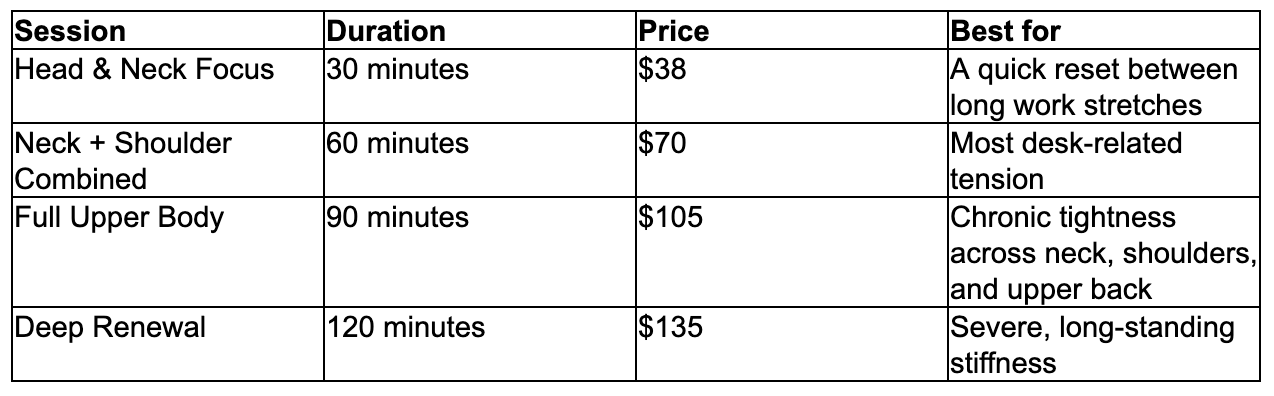
For most people who sit at a desk full time, the 90-minute session is the realistic starting point: enough time to work through the neck, both shoulders, and the upper back without rushing any one area.
How Often You Should Book If You Sit All Day
A single session helps, but it does not undo months or years of the same posture. Most clients notice a real difference within two to three sessions. If the pain is active, weekly sessions for two to four weeks tend to break the cycle; after that, a maintenance visit every two to three weeks is usually enough to keep it from building back up, especially if it is paired with small changes at the desk itself, like monitor height and regular movement breaks.
When It's More Than a Desk-Posture Problem
Massage is genuinely effective for the muscular tightness that desk work causes, but it is not the right first step for everything that can feel like it. If pain radiates down the arm, or if there is numbness or tingling in the hand or fingers, that can point to nerve involvement, such as thoracic outlet syndrome or a cervical disc issue, rather than simple muscle tightness. That is worth checking with a physician before booking a massage, not after.
Frequently Asked Questions
What is the best type of massage for someone who sits at a desk all day?
A combined neck and shoulder session, not just one or the other. Desk posture tightens the upper trapezius, levator scapulae, and pectoralis minor together, so treating only the neck or only the shoulders tends to bring the tightness right back.
Should I book a neck massage or a shoulder massage first?
If you had to choose one, start with whichever area is more painful right now. But for most desk workers, a 90-minute session that covers both areas in one visit is more effective than alternating between two shorter, separate sessions.
How long before I feel relief?
Many clients feel looser immediately after the first session, but lasting change in a long-standing postural pattern usually takes two to three sessions, with weekly visits if the pain is active.
Does Easy Cozy Wellness accept insurance for desk-related pain?
Easy Cozy's practitioners are NHPC members, not RMTs, so most extended health plans that specifically require an RMT will not cover sessions. A receipt is provided for every visit in case your plan covers NHPC providers.
Ready to book? You can reserve a session directly at easycozy.ca/booking, or read more about how we approach neck pain and shoulder pain specifically. Easy Cozy Wellness is located at 6418 Dover Rd, Nanaimo, open Tuesday to Saturday, 10am to 8pm.
Easy Cozy Wellness is a Nanaimo-based massage therapy studio led by Lillian Lian, NHPC. We focus on targeted, technique-specific treatment for pain rather than general relaxation massage, and we write about the mechanics behind common pain patterns so clients understand what they're booking and why.

