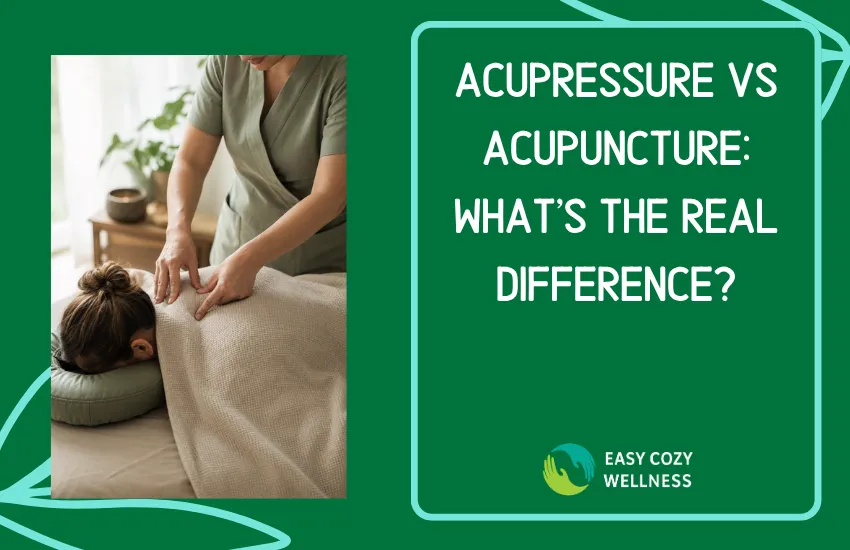
Acupressure vs Acupuncture: What's the Real Difference?
Acupressure vs acupuncture comes down to one key difference: acupressure uses focused finger, thumb, or palm pressure on the body's meridian points, while acupuncture uses thin needles inserted at those same points. Both are rooted in traditional Chinese medicine and both are practiced by our team at Easy Cozy Wellness in Nanaimo, in the sense that we use acupressure as part of our hands-on treatment approach. If you're trying to decide which one fits your comfort level and your goals, here's what actually sets them apart.
What Is Acupressure vs Acupuncture, Exactly?
Acupuncture involves a licensed acupuncturist inserting sterile, hair-thin needles into specific points along the body's meridians, the energy pathways described in traditional Chinese medicine. The needles typically stay in place for 15 to 30 minutes while the client rests. Acupressure, by contrast, uses manual pressure, applied with fingers, thumbs, knuckles, or sometimes elbows, on those same meridian points. No needles are involved at any stage.
Physiopedia describes both approaches as originating from the same theoretical framework in traditional Chinese medicine, with the shared goal of stimulating specific points to influence pain, tension, and the body's energy flow, though the delivery method is fundamentally different.
Do Acupressure and Acupuncture Use the Same Points?
Largely, yes. Both disciplines draw on the same map of meridian points and pressure points that traditional Chinese medicine has documented for centuries. A point used to relieve tension headaches or lower back pain in acupuncture is often the same point a skilled acupressure practitioner will target with sustained finger pressure. The theory behind why these points matter is shared; the tool used to stimulate them is not.
Which Is More Effective, Acupressure or Acupuncture?
This is the question most people actually want answered, and the honest response is that effectiveness depends on the condition, the individual, and personal comfort with needles. Research summarized by Physiopedia notes that both approaches have shown benefit for conditions like tension headaches, lower back pain, and general muscle tightness, though the depth and specificity of stimulation can differ between the two.
In practical terms, acupuncture can sometimes reach a more precise, sustained stimulation of a single point because the needle stays in place. Acupressure relies on the skill and pressure control of the practitioner's hands, but it has real advantages: no needles, no puncture risk, and it can be combined seamlessly with massage techniques like tuina or deep tissue work in the same session, which is not something acupuncture, delivered on its own by a licensed acupuncturist, typically includes.
Is Acupressure Painful the Way Needles Can Be?
Most clients describe acupressure as firm, sometimes intense in the moment on a particularly tight point, but not painful in the way a needle insertion can briefly be for people with needle sensitivity. This is one of the most common reasons clients choose acupressure over acupuncture: needle anxiety is real and common, and acupressure offers a needle-free way to access many of the same pressure points.
The NHS notes that acupuncture needles are generally described as causing minimal discomfort during insertion, but for clients with a genuine needle phobia, that minimal discomfort can still be a barrier to treatment altogether, which is where acupressure becomes a practical alternative rather than a lesser one.
Who Should Choose Acupressure Instead of Acupuncture?
Acupressure tends to be the better fit if you:
Have a needle phobia or general discomfort with the idea of needle insertion
Want pressure point work combined with broader massage techniques like deep tissue or tuina in the same session
Are looking for a treatment option that doesn't require a licensed acupuncturist's medical scope of practice
Prefer a practitioner who can also address surrounding muscle tension, not just isolated points
Acupuncture may be worth exploring separately, through a licensed acupuncturist, if you have a specific condition where research points to needle-based stimulation offering more targeted or sustained results, such as certain chronic pain conditions where deeper, longer-held stimulation is part of the treatment plan.
When Should You See an Acupuncturist Instead of a Massage Practitioner?
We want to be upfront here: our practitioners at Easy Cozy Wellness are NHPC members who use acupressure as part of massage-based treatment. We are not acupuncturists, and we don't perform needle-based acupuncture. If a specific condition genuinely calls for needle acupuncture, such as complex chronic pain management under a treatment plan that includes needling, that requires a licensed acupuncturist, and we'll say so honestly rather than suggesting acupressure as a direct substitute in every case. Where the two genuinely overlap, general tension, stress-related tightness, common headache and back pain patterns, acupressure through massage is a reasonable, needle-free starting point.
Frequently Asked Questions
Is acupressure as effective as acupuncture for pain relief? For many common conditions like tension headaches and general muscle tightness, both approaches show meaningful benefit. Acupressure is a solid, needle-free option, though some specific chronic conditions may respond better to sustained needle stimulation from a licensed acupuncturist.
Can I get acupressure and acupuncture on the same day? There's no medical reason you couldn't, though most clients choose one approach at a time to gauge how their body responds. If you're combining both, space them out and mention it to each practitioner.
Does acupressure hurt? It can feel firm or intense on a particularly tight point, but it shouldn't be sharply painful. Communicate with your practitioner about pressure level at any point during a session.
Is acupressure covered by insurance the way acupuncture sometimes is? Our practitioners are NHPC members, not RMTs or licensed acupuncturists, so we don't bill extended health insurance directly. Some plans do reimburse NHPC-provided treatments; check your specific policy for details.
Final Suggestion: If tension and tightness are your main concern rather than a specific condition needing needle-based treatment, a session combining acupressure with tuina techniques is often the most complete approach, and it pairs well with what we cover in how acupressure relieves back pain. For a broader look at how these techniques apply to muscle tightness in general, our deep tissue massage guide explains where pressure point work and deeper muscle work overlap. You can book a session directly at easycozy.ca/booking.

