5 Real Reasons Your Neck Feels Tight All the Time
5 Real Reasons Your Neck Feels Tight All the Time
A neck that feels tight all the time is not just tension; it is a pattern. The reason your neck feels tight all the time is almost always a combination of sustained muscle overload, poor head position relative to your shoulders, and a group of small deep muscles that never get a proper chance to fully relax.
This pattern is extremely common and it tends to get progressively worse without intervention. The good news is that it is well understood and responds very well to targeted treatment. This post explains the five main causes, what the constant tightness is actually telling you, and what you can do to break the pattern.
Table of contents
1. What causes your neck to feel tight all the time
2. Why neck tightness keeps coming back
3. What your tight neck is actually telling you
4. What you can do about neck tightness
5. When to get professional help
6. Neck and shoulder tightness treatment in Nanaimo
7. Frequently asked questions
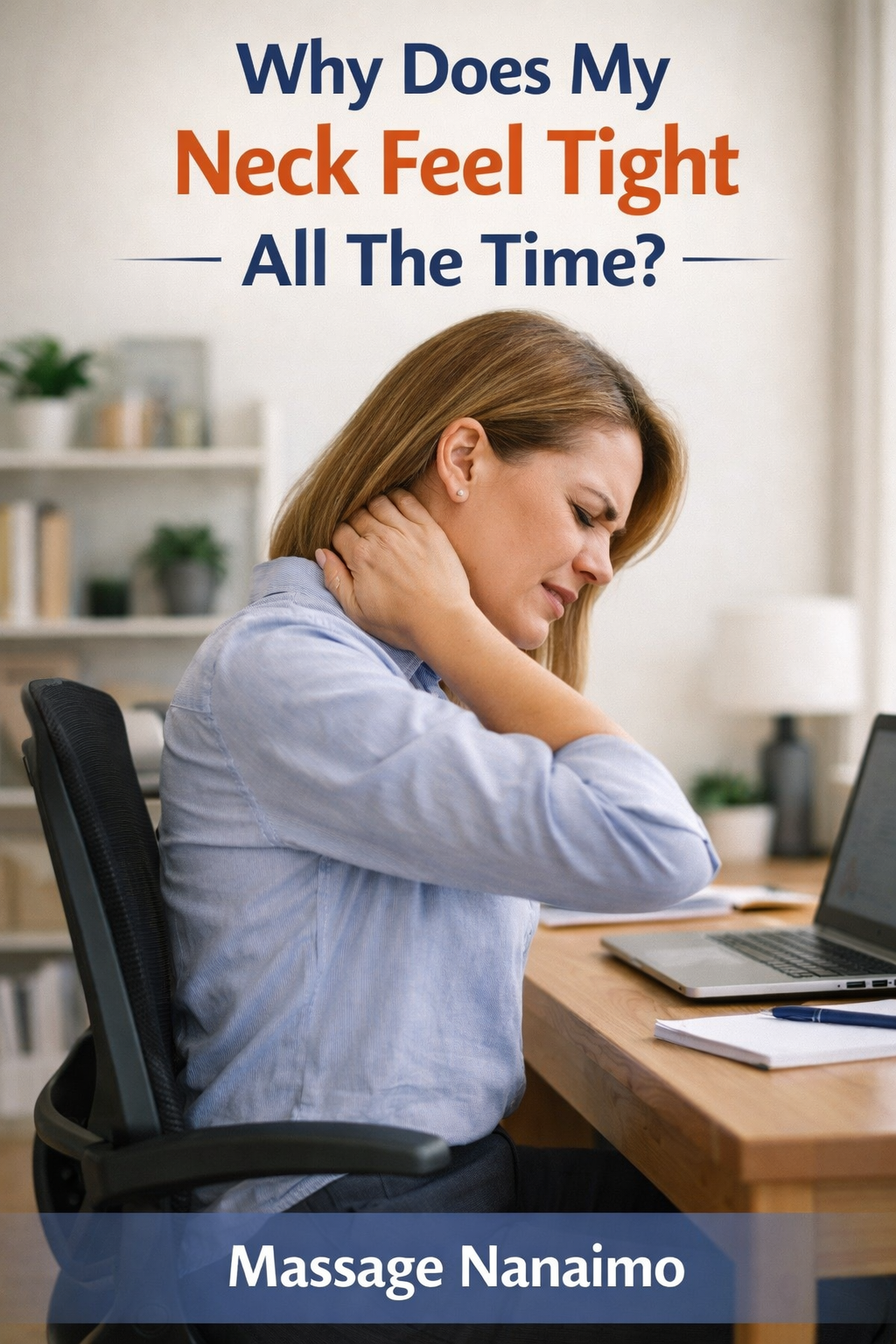
What causes your neck to feel tight all the time
Neck tightness that never fully resolves between days has specific causes. Temporary tightness after a bad night's sleep is one thing. Tightness that is just always there, regardless of how much you rest, is another, and it has a different explanation.
1. Forward head posture
Every centimetre your head moves forward of your shoulders adds roughly 4.5kg of effective load on the cervical spine and the muscles that support it. According to Physiopedia, the average person's head shifts 2.5 to 4 centimetres forward when using a screen at typical desk height, creating a sustained overload on the suboccipital, levator scapulae and upper trapezius muscles. This is the most common structural driver of chronic neck tightness.
2. Upper trapezius overuse
The upper trapezius runs from the base of your skull down to your shoulder blade. When you hold your shoulders slightly raised, which most people do when stressed, concentrating, or sitting at a keyboard, this muscle is in a state of constant low-level contraction. Over months, it develops trigger points: tight, hypersensitive knots that refer pain upward into the neck and base of the skull.
3. Levator scapulae tension
The levator scapulae connects your cervical vertebrae to your shoulder blade. It is responsible for both lifting the shoulder blade and rotating the neck. When you spend long hours with your arm elevated slightly, as happens when using a mouse or typing, this muscle is working continuously. Sustained levator tension is the most common cause of the specific type of neck tightness that runs from the base of the skull diagonally down toward the shoulder.
4. Suboccipital muscle overload
The suboccipital muscles are a group of four small muscles at the base of your skull. They control fine adjustments of head position. When you tilt your head slightly forward or hold it very still for long periods, exactly what happens when you read a screen, these muscles lock up. Suboccipital tension is the primary driver of the heavy, vice-like sensation many people describe at the back of the neck and base of the skull.
5. Stress-related muscle guarding
Psychological stress causes the body to adopt a bracing posture: shoulders rise, jaw clenches, and the muscles around the neck and upper back contract. The Canadian Mental Health Association notes that muscle tension is one of the most common physical symptoms of chronic stress, with the neck and shoulder region being the most frequently affected area. When stress is ongoing, this muscle guarding becomes the resting baseline, and the neck never fully releases.
Why neck tightness keeps coming back
The pattern of neck tightness that returns every day, or never fully goes away, follows a predictable cycle. Muscles overloaded by sustained poor posture develop trigger points. Trigger points generate low-level pain signals, which cause the surrounding muscles to contract further as a protective response. That additional contraction creates more trigger points. The cycle perpetuates itself.
Simply resting does not break this cycle. The muscles do not release trigger points through inactivity, they need direct mechanical intervention. This is why neck tightness that has been present for more than a few weeks rarely resolves without treatment. For relief that lasts, targeted neck and shoulder massage in Nanaimo works directly on the trigger points and fascial restrictions driving the pattern.
What your tight neck is actually telling you
Constant neck tightness is not just discomfort, it is information. The specific location and character of the tension often points to which muscles are most affected.
Tightness running from base of skull to shoulder blade: levator scapulae - usually posture and arm position related
Pressure or heaviness at the base of the skull: suboccipital muscles - usually screen time and forward head position
Tightness across the top of the shoulders and into the neck: upper trapezius - usually stress and shoulder elevation
One-sided tightness that worsens when turning the head: often a combination of levator and scalene muscles on the affected side
Tightness that comes with headaches: typically suboccipital and upper trapezius trigger points referring pain upward
Understanding which muscles are involved helps you choose the right treatment - and explains why general neck stretches only provide temporary relief if they are not targeting the right structures.
What you can do about neck tightness
Immediate relief
Chin tucks: gently retract your chin straight back (not down) 10 times hourly. This directly counters forward head posture and decompresses the suboccipital muscles.
Shoulder blade squeezes: pull your shoulder blades together and down for 5 seconds, 10 repetitions. This switches off the upper trapezius shrug pattern.
Heat application: 15-20 minutes of heat on the upper trapezius and neck before bed. Heat increases blood flow and reduces trigger point activity.
Screen height check: your eye level should meet the top third of your screen. If you are looking down, your levator scapulae and suboccipitals are working constantly.
Addressing the root cause
The most effective treatment for chronic neck tightness is hands-on work that deactivates the specific trigger points driving the pattern. A 2024 systematic review published by the NHS confirmed that massage therapy, particularly techniques targeting the upper trapezius and suboccipital muscles, produces significant and sustained reduction in neck pain and stiffness compared to self-managed approaches.
At Easy Cozy, deep tissue massage and acupressure are applied specifically to the structures most involved in desk-related neck tightness. Acupressure along the levator scapulae and suboccipital lines is particularly effective, many clients describe it as the first treatment that reaches the exact location of the problem rather than just working around it.
If your neck has felt tight for weeks or months and nothing has fully resolved it, you are not alone. This is one of the most common patterns we see at Easy Cozy.
Book a session and let us identify exactly which muscles are driving your tightness.
Book Now: https://easycozy.ca/booking
When to get professional help
Neck tightness from muscle overload is very common and very treatable. However, some presentations need medical assessment before massage treatment.
Tingling, numbness or weakness in one or both arms or hands
Neck pain that started after an accident or fall
Neck stiffness severe enough to prevent normal head rotation
Tightness accompanied by fever, severe headache or changes in vision
Neck pain that is significantly worse at night when lying flat
If any of those apply, see your GP before booking treatment. If none apply and your tightness is the familiar, persistent, desk-related pattern, massage therapy is an appropriate and effective first step.
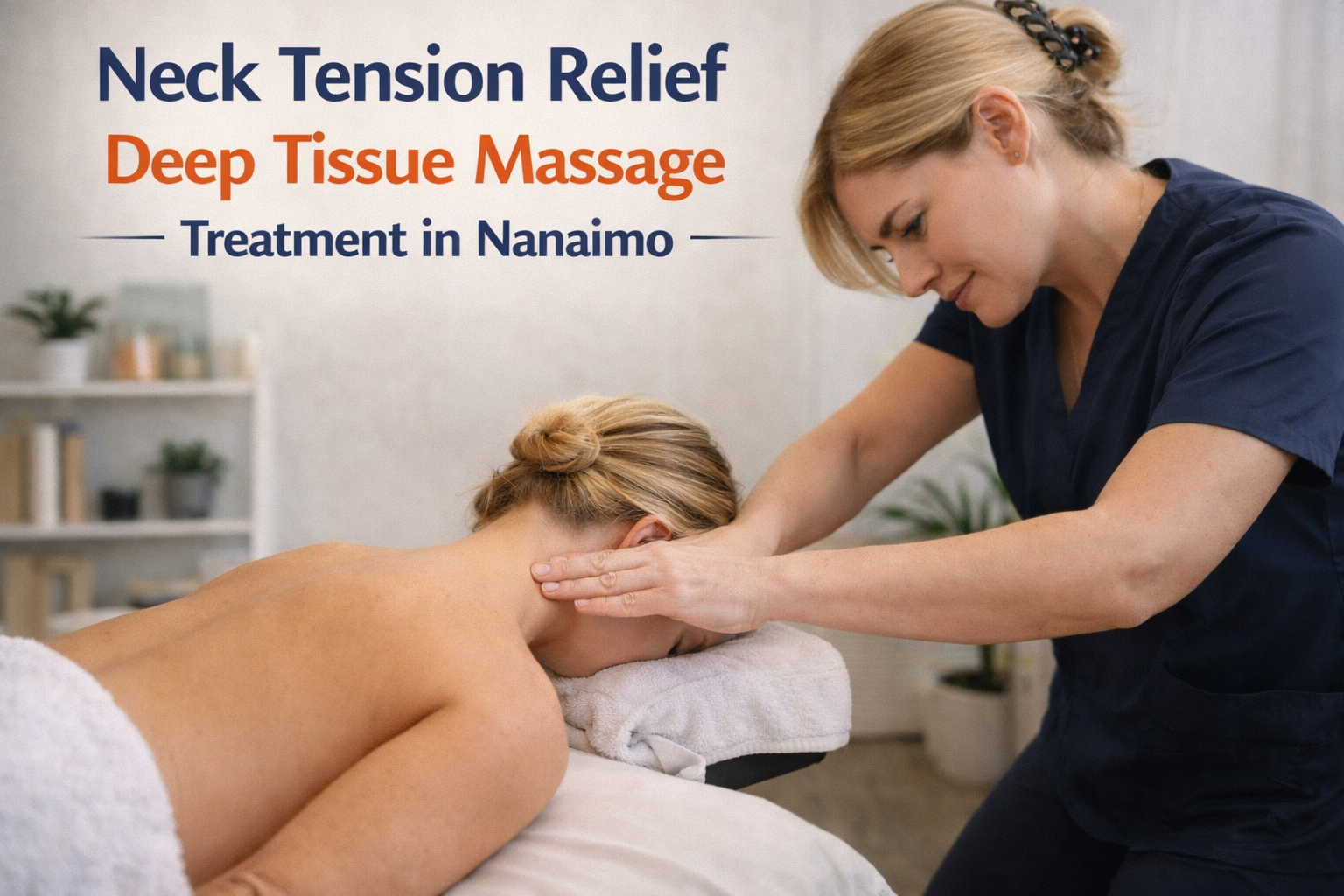
Neck and shoulder tightness treatment in Nanaimo
Neck tightness from sustained muscle overload is one of the most frequently treated conditions at Easy Cozy in Nanaimo. The people we see most often are office workers and remote workers who have been carrying the same tightness for months, sometimes years, without finding a treatment that reaches the root of the problem.
At Easy Cozy, we do not need a referral and there is no waiting list. Most people can book within the same week. Sessions focus on the specific muscles identified in the assessment: suboccipitals, levator scapulae, and upper trapezius are the most commonly involved. We use a combination of deep tissue massage and acupressure - the acupressure component is particularly effective for the deep suboccipital and levator work that standard massage does not always reach.
If you have been managing neck tightness with heat, stretching and self-massage without lasting results, a targeted session addressing the underlying neck and shoulder trigger points in Nanaimo typically produces relief within the first treatment.
If your neck has felt tight for weeks or months without real relief, book a session at Easy Cozy. We will identify exactly which muscles are involved and treat the source directly.
Book Now: https://easycozy.ca/booking
Frequently asked questions
Why does my neck feel tight all the time even when I rest?
Neck tightness that persists even during rest is caused by trigger points - tight, hypersensitive knots in the upper trapezius, levator scapulae and suboccipital muscles. These do not release through rest alone. They generate a low-level pain signal that keeps the surrounding muscles contracted as a protective response, which is why the tightness never fully disappears even on weekends or after a full night's sleep.
How long does it take for chronic neck tightness to improve?
Most people with long-standing neck tightness notice meaningful improvement within one to three massage sessions targeting the specific muscles involved. The tightness has usually been building for months, so a single session produces significant but not complete relief. A short course of two to four sessions, combined with posture corrections and regular movement breaks, typically resolves the pattern for most people.
Should I see someone about my neck tightness or is stretching enough?
Stretching helps manage neck tightness but rarely resolves it fully once trigger points are established. If your neck has felt tight for more than two to three weeks and stretching is only providing temporary relief, hands-on treatment will be considerably more effective. Massage targets the trigger points and fascial restrictions that stretching cannot reach. See a GP first if you have arm tingling, numbness or post-accident neck pain.
Why does my neck feel tight on one side more than the other?
One-sided neck tightness almost always reflects an asymmetry in how you use your body. your mouse arm, the direction you habitually turn your head to look at a second screen, or a pattern of resting your chin on one hand. The muscles on the dominant side accumulate more load and develop trigger points faster. The levator scapulae on the mouse arm side is one of the most commonly overloaded muscles we treat at Easy Cozy.
Final Suggestion
If you’re looking for massage therapy in Nanaimo that helps you feel relaxed, refreshed, and back to your best, Easy Cozy Wellness is here to help.
We focus on real results, not just temporary relief. Whether you’re dealing with daily tension, chronic discomfort, or simply need time to unwind, our treatments are designed to support your body and your overall well-being.
We regularly help clients with:
Sciatic pain (sciatica)
Hip pain
Knee pain
Elbow pain (tennis elbow, golfer’s elbow)
Leg pain and muscle tightness
Foot pain and plantar fasciitis
Hand and wrist pain (including carpal tunnel symptoms)
Joint pain and inflammation
Muscle soreness and post-workout recovery
Chronic pain conditions
Nerve pain and tension
Upper back and mid-back pain
Glute pain and piriformis syndrome
Calf tightness and strain
Shin splints
Ankle pain and mobility issues
Postural pain from sitting or desk work
Repetitive strain injuries (RSI)
Stress, tension, and fatigue
Our services include:
Relaxation massage
Deep tissue massage
Therapeutic massage
Pain relief massage
Stress relief treatments
Wellness and recovery sessions
Preventative body care
At Easy Cozy Wellness, the goal is simple. Help your body feel better, move better, and recover faster.
If you’ve been searching for:
massage therapy Nanaimo
best massage Nanaimo
affordable massage Nanaimo
deep tissue massage Nanaimo
relaxation massage Nanaimo
pain relief massage Nanaimo
wellness clinic Nanaimo
You’re in the right place.
Give us a call at 778-561-0208 and book your next wellness appointment today.
Or visit https://easycozy.ca/ to learn more about our services, see current offers, and review our satisfaction guarantee.
We’re proud to offer a more affordable option compared to many local providers, without compromising on quality or results.
Once you experience the difference, you’ll understand why so many people choose Easy Cozy Wellness for ongoing care.
You can schedule your massage appointment here:
Relaxation is not a luxury — it’s an essential part of staying healthy and energized.
Your body will thank you. Talk soon.

