5 Real Reasons Why Your Lower Back Hurts After Sitting
5 Real Reasons Why Your Lower Back Hurts After Sitting
Lower back pain after sitting comes from a predictable combination of spinal compression, shortened hip flexors, and glute muscles that stop working the moment you sit down. Why does your lower back hurt after sitting? Because the human spine was designed for movement, not for hours of static load, and every long stint at a desk adds to a cumulative strain that eventually becomes pain.
This is not a sign of serious injury for most people. It is your body responding to a position it was never built to hold for eight hours straight. This post explains the five real causes, why the pain keeps returning even after rest, and what actually works to stop it.
Table of contents
1. What causes lower back pain after sitting
2. Why lower back pain keeps coming back
3. What you can do about lower back pain after sitting
4. When to get professional help
5. Lower back pain after sitting in Nanaimo
6. Frequently asked questions
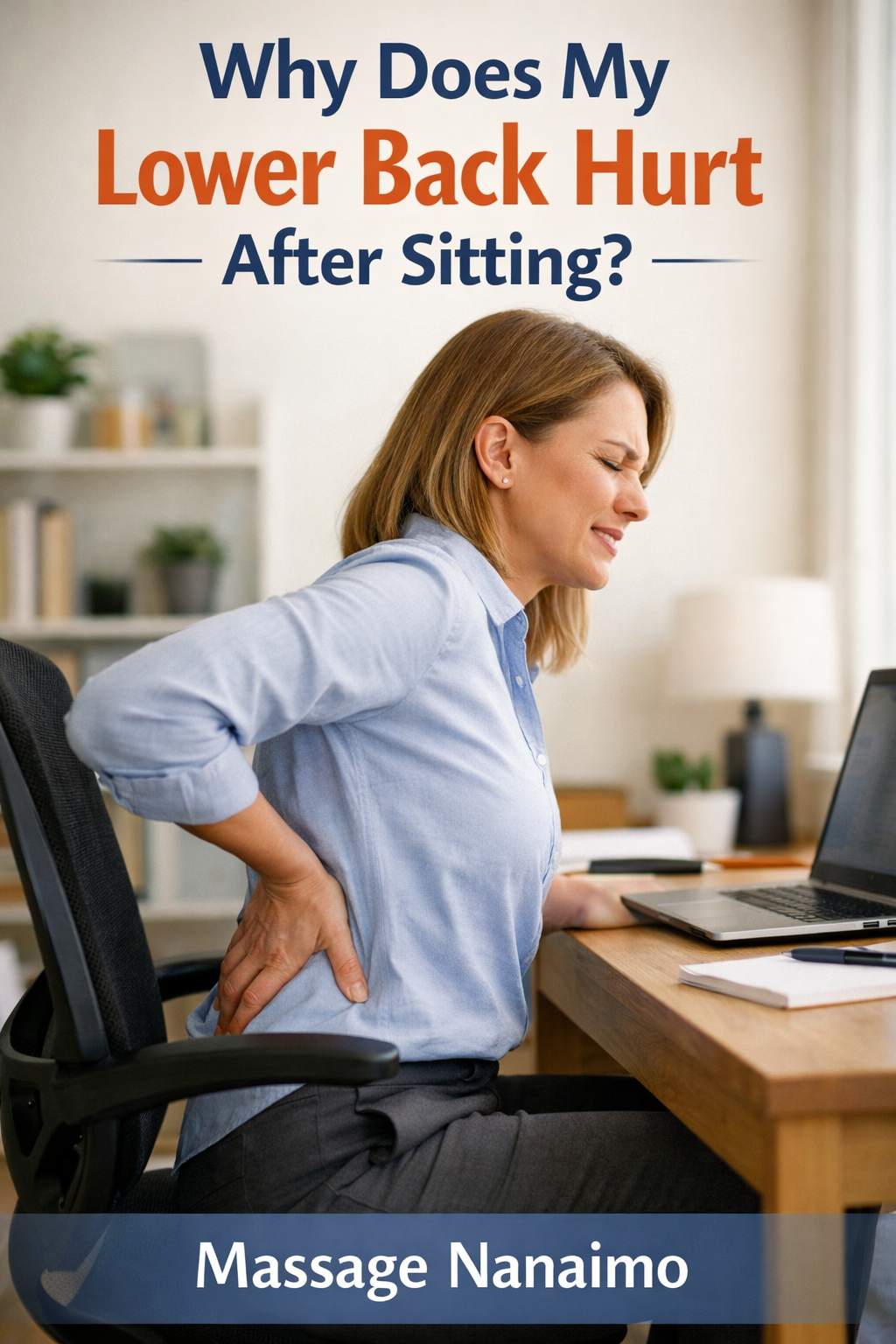
What causes lower back pain after sitting
There are five distinct mechanisms at work. Most people dealing with lower back pain after sitting have at least three of them happening simultaneously.
1. Lumbar disc compression
Your spinal discs act as cushions between the vertebrae. Sitting, especially with a forward-leaning posture, compresses these discs unevenly. The lumbar discs at L4-L5 and L5-S1 take the heaviest load. According to research published in the European Spine Journal, intradiscal pressure in the lumbar spine increases significantly in seated postures compared to standing, particularly when the natural lumbar curve flattens.
2. Hip flexor tightening
When you sit, your hip flexors, the muscles connecting your thighs to your lower spine, stay in a shortened position for hours. Over time, they tighten and begin pulling your pelvis forward into an anterior tilt. That constant forward pull places sustained strain on your lower back joints and muscles, even when you stand up and walk away from the desk.
3. Glute muscle shutdown
Sitting switches your glutes off. These are the largest and most powerful muscles in your body, and one of the primary support structures for your lower spine. When they are inactive for hours, your lower back has to compensate and carry load it was not designed to manage alone. This is often the single biggest driver of end-of-day lower back pain in desk workers.
4. Poor sitting posture
Most people do not sit with a neutral spine. They round the lower back, slouch forward, or twist slightly to one side to reach a keyboard or phone. Each of these patterns gradually loads specific muscles and joints in a way that accumulates into pain over months.
5. No movement breaks
The spine needs regular movement to pump nutrients into spinal discs and flush out metabolic waste, the byproducts of normal muscle activity. When you sit without moving for 45 minutes or more, this process slows significantly. The Public Health Agency of Canada notes that prolonged sedentary behaviour is a significant risk factor for musculoskeletal pain, including lower back pain.
Why lower back pain keeps coming back
Most people stretch a bit, feel some relief, and then the pain returns within a day or two. This is not bad luck. It follows a completely predictable pattern.
When your hip flexors are chronically tight and your glutes are chronically weak, your lower back is always working harder than it should. Stretching provides temporary relief by lengthening the shortened muscles, but it does not reset the underlying imbalance. The moment you sit back down for several hours, the tightening process begins again.
This is why lower back pain from sitting tends to get progressively worse over months if left unaddressed. Each working day adds a small increment of cumulative tension to already-overloaded structures. Addressing it through targeted massage and acupressure for lower back pain breaks that cycle at the tissue level rather than just managing symptoms.
What you can do about lower back pain after sitting
There are things you can do right now for immediate relief, and things that address the root cause. Both matter, but they work on different timescales.
Immediate steps
•Stand and walk for 2-3 minutes every 45 minutes of sitting. Set a timer, you will not do this without one.
•Place a small rolled towel at your lower back when seated to restore the lumbar curve.
•Stretch your hip flexors daily: low lunge position, hold 30 seconds each side.
•Do 10 slow glute bridges morning and evening to reactivate the muscles sitting switches off.
Addressing the root cause
The fastest way to resolve the underlying muscle imbalances driving your lower back pain is direct, hands-on treatment. Massage therapy works on the shortened hip flexors, locked lumbar muscles, and compressed spinal tissue in a way that stretching and movement breaks alone cannot fully reach.
Deep tissue massage and acupressure target the specific muscle groups involved in desk-related lower back pain. A 2024 systematic review in JMIR found that therapeutic massage significantly reduced pain intensity and improved function in participants with non-specific lower back pain. Learn more.
Many clients notice meaningful relief after a single session, with sustained improvement over a short course of treatment. The combination of deep tissue work on the lumbar muscles and acupressure on the hip flexors and glute complex is particularly effective for the sitting-related pattern.
If this sounds familiar, you are not alone. Most of our clients at Easy Cozy came to us with exactly this problem. Lower back pain from sitting is one of the most common things we treat.
Book a session and let us find the source. Book Now: easycozy.ca/booking
When to get professional help
Most lower back pain from sitting is muscular and responds well to massage therapy. But there are specific signs that mean you should seek a medical assessment before booking treatment.
•Pain that radiates down one or both legs, particularly past the knee
•Numbness, tingling or weakness in the legs or feet
•Pain that is significantly worse first thing in the morning before you have sat at all
•Lower back pain that has not improved at all in more than three weeks
•Pain accompanied by any change in bladder or bowel function
If none of those apply, your pain is almost certainly muscular and responds very well to targeted massage. If any do apply, see your GP or physiotherapist for an assessment before pursuing massage therapy.
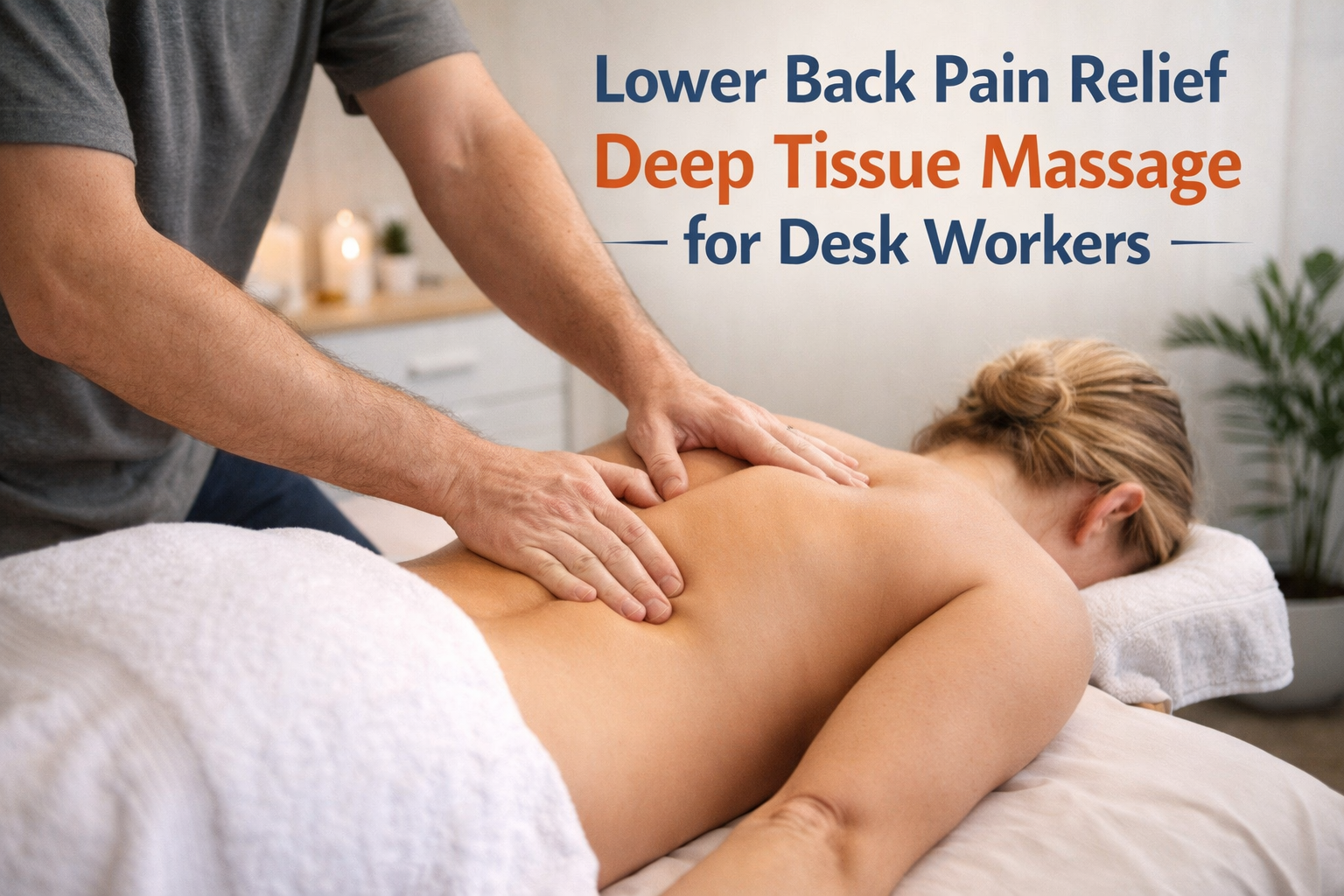
Lower back pain after sitting in Nanaimo
Nanaimo has a large and growing population of desk workers, remote workers, tradespeople, students and seniors, and lower back pain from prolonged sitting is consistently one of the most frequent complaints we see at Easy Cozy.
Unlike a physiotherapy clinic or GP practice, there is no referral required and no waitlist. Most clients can book a session within the same week. At Easy Cozy in Nanaimo, we use a combination of deep tissue massage and acupressure to address the specific muscle groups involved in desk-related lower back pain: the hip flexors, lumbar erectors, and glute complex.
Sessions run 60 or 90 minutes depending on the severity and spread of the pain. If you have never tried acupressure before, it works differently to standard massage, it applies sustained pressure to specific points along the muscle and fascial lines that are most affected by sitting. Many clients who have tried other lower back pain treatments in Nanaimo without lasting results find acupressure produces a notably different and more sustained response.
If this sounds familiar, you are not alone. Most of our clients at Easy Cozy came to us with exactly this problem.
Book a session and let us find the source of your lower back pain.
Book Now: easycozy.ca/booking
Frequently asked questions
Why does my lower back hurt after sitting for a long time?
Lower back pain after sitting comes from three mechanisms working together: spinal disc compression, hip flexor tightening, and glute muscle shutdown. When you sit for extended periods your lumbar spine loses its natural curve, the hip flexors shorten and pull the pelvis forward, and the glutes stop firing, leaving the lower back to carry load it is not designed to handle alone.
How long does lower back pain from sitting usually take to improve?
Lower back pain from sitting can last a few hours to several weeks depending on how long the pattern has been building. If you have been sitting long hours for months, the underlying muscle imbalances take more than rest to resolve. Most clients who receive targeted massage therapy notice meaningful improvement within one to three sessions. Consistent movement breaks during the day speed the recovery.
Should I see someone about my lower back pain from sitting or wait it out?
If the pain is affecting your work, sleep or daily activities, do not wait. Lower back pain from sitting rarely resolves on its own because the cause, the sitting itself, has not changed. Early treatment is faster, more effective, and prevents the pattern from becoming chronic. See a GP first if you have any radiating leg pain, numbness, or tingling.
Why does my lower back hurt more on one side after sitting?
One-sided lower back pain from sitting is almost always caused by an asymmetrical sitting posture, favouring one side when leaning, crossing the legs repeatedly, or reaching habitually to one side for a keyboard or mouse. This creates uneven muscle loading so one hip flexor and one set of lumbar muscles work harder than the other, producing pain on the overloaded side.
Final Suggestion
If you’re looking for massage therapy in Nanaimo that helps you feel relaxed, refreshed, and back to your best, Easy Cozy Wellness is here to help.
We focus on real results, not just temporary relief. Whether you’re dealing with daily tension, chronic discomfort, or simply need time to unwind, our treatments are designed to support your body and your overall well-being.
We regularly help clients with:
• Sciatic pain (sciatica)
• Hip pain
• Knee pain
• Elbow pain (tennis elbow, golfer’s elbow)
• Leg pain and muscle tightness
• Foot pain and plantar fasciitis
• Hand and wrist pain (including carpal tunnel symptoms)
• Joint pain and inflammation
• Muscle soreness and post-workout recovery
• Chronic pain conditions
• Nerve pain and tension
• Upper back and mid-back pain
• Glute pain and piriformis syndrome
• Calf tightness and strain
• Shin splints
• Ankle pain and mobility issues
• Postural pain from sitting or desk work
• Repetitive strain injuries (RSI)
• Stress, tension, and fatigue
Our services include:
• Relaxation massage
• Deep tissue massage
• Therapeutic massage
• Pain relief massage
• Stress relief treatments
• Wellness and recovery sessions
• Preventative body care
At Easy Cozy Wellness, the goal is simple. Help your body feel better, move better, and recover faster.
If you’ve been searching for:
massage therapy Nanaimo
best massage Nanaimo
affordable massage Nanaimo
deep tissue massage Nanaimo
relaxation massage Nanaimo
pain relief massage Nanaimo
wellness clinic Nanaimo
You’re in the right place.
Give us a call at 778-561-0208 and book your next wellness appointment today.
Or visit https://easycozy.ca/ to learn more about our services, see current offers, and review our satisfaction guarantee.
We’re proud to offer a more affordable option compared to many local providers, without compromising on quality or results.
Once you experience the difference, you’ll understand why so many people choose Easy Cozy Wellness for ongoing care.
You can schedule your massage appointment here:
Relaxation is not a luxury — it’s an essential part of staying healthy and energized.
Your body will thank you. Talk soon.

