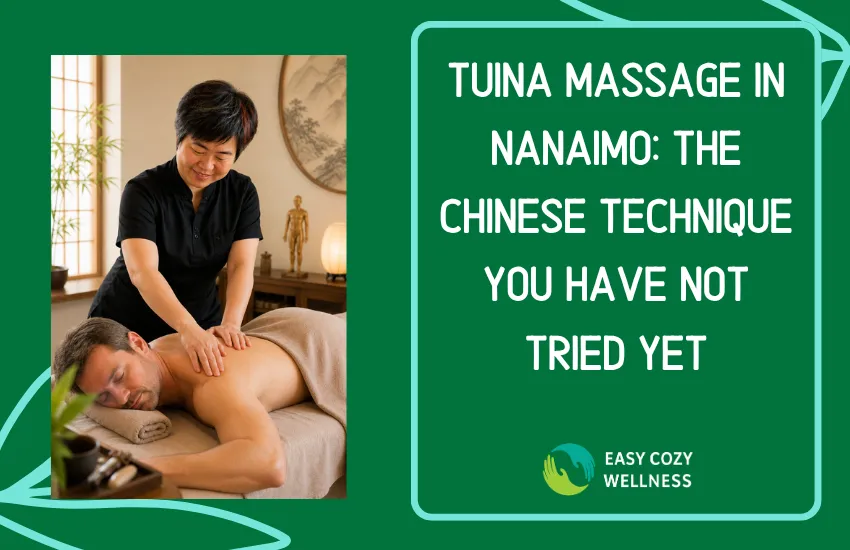
Tuina Massage in Nanaimo: The Chinese Technique You Have Not Tried Yet
Tuina Massage in Nanaimo: The Chinese Technique You Have Not Tried Yet
Most people searching for tuina massage in Nanaimo have already tried standard relaxation massage, deep tissue work, or physiotherapy, and are looking for something that reaches the problem differently. That instinct is correct. Tuina is not a variation of Western massage. It is a fundamentally different system of manual therapy with a two-thousand-year clinical history, a distinct theoretical framework, and a set of techniques that produce outcomes that broad surface massage cannot replicate.
This post covers what tuina massage actually involves in a clinical session, what conditions it addresses most effectively, what to expect if you book a tuina-based acupressure session at Easy Cozy Wellness in Nanaimo, and why it is the technique we use as the foundation of every session we deliver.
Tuina Massage in Nanaimo: What It Is and Where It Comes From
Tuina is a system of Chinese therapeutic bodywork that applies sustained manual pressure, rhythmic compression, and directional manipulation to specific points and muscle channels on the body. It is one of the five core pillars of traditional Chinese medicine alongside acupuncture, herbal medicine, dietary therapy, and qi gong.
The technique has been documented in Chinese medical literature for over two thousand years. It was formally systematised during the Ming dynasty (1368 to 1644) and has been continuously refined through clinical practice since. Today, tuina is taught as a degree-level subject in Chinese medical universities and is practiced in both traditional and integrative clinical settings worldwide.
At Easy Cozy Wellness in Nanaimo, our acupressure technique draws directly from the point-specific pressure principles of the tuina tradition. Lillian, our NHPC member practitioner, applies sustained directional pressure to the same anatomical locations that tuina practitioners have used for millennia, refined through contemporary knowledge of myofascial trigger points and fascial anatomy.
What Makes Tuina Different from Standard Massage
The distinction that matters most in a clinical context is specificity. Standard Western massage works across the surface of the muscle with broad strokes designed to increase circulation and produce relaxation. This is genuinely useful for stress reduction and mild tension. It is not sufficient for chronic pain conditions where the source of the problem is an embedded trigger point, a fascial restriction, or a compressed nerve pathway sitting well beneath the surface layer.
Tuina works differently in three key respects:
Point specificity: pressure is applied to precise anatomical locations rather than broad muscle regions. The suboccipital muscles at the base of the skull, for example, are not just massaged in the general neck area. Each of the four suboccipital muscles is individually located and addressed with sustained pressure until it releases.
Sustained hold: tuina techniques use prolonged pressure holds, often 60 to 90 seconds on a single point, to allow the tissue to fully release. Standard massage uses continuous movement. The sustained hold is what produces the Golgi tendon organ reflex response that genuinely deactivates a trigger point rather than temporarily suppressing it.
Directional intention: pressure is applied in specific directions aligned with the muscle fibre orientation or the traditional channel pathway. This directional element affects how the myofascia responds to the pressure and distinguishes tuina from pressing hard on a sore spot without a structural framework.
Conditions Tuina Massage Addresses Most Effectively in Nanaimo
The clinical evidence for tuina-based acupressure is strongest for musculoskeletal pain conditions. The following are the presentations most commonly treated at Easy Cozy Wellness using tuina-derived techniques:
Chronic Neck and Cervicogenic Headache
The suboccipital release central to tuina practice is one of the most evidence-supported manual interventions for both chronic neck pain and cervicogenic headache. A 2021 systematic review published in the Journal of Pain Research found that acupoint pressure to the cervical region produced statistically significant reductions in both neck pain intensity and headache frequency compared to sham treatment, with effects persisting at 12-week follow-up.
Chronic Lower Back Pain
Tuina has the largest evidence base of any traditional Chinese medicine intervention for chronic lower back pain. A 2020 Cochrane review identified acupressure as producing significant short-term reductions in chronic lower back pain intensity, with a mean difference of 25 points on a 100-point pain scale compared to control groups. The key anatomical targets in a lower back tuina session are the erector spinae, quadratus lumborum, and gluteal attachments at the sacrum and iliac crest.
Shoulder Restriction and Rotator Cuff Tension
The infraspinatus, supraspinatus, and subscapularis attachments that drive most shoulder restriction are ideal targets for tuina-based sustained pressure. The technique allows specific work at the musculotendinous junction, which is where the majority of rotator cuff tension accumulates and where broad surface massage cannot reach with sufficient specificity.
Stress, Anxiety, and Sleep Disruption
The sustained pressure component of tuina reliably activates the parasympathetic nervous system. Research published in the journal Evidence-Based Complementary and Alternative Medicine found that regular acupressure sessions produced measurable reductions in salivary cortisol, self-reported anxiety scores, and sleep onset time compared to control groups. This systemic relaxation effect occurs regardless of whether the primary treatment target is a pain condition or stress management.
What to Expect in a Tuina-Based Acupressure Session at Easy Cozy Wellness
A tuina-based session at Easy Cozy Wellness in Nanaimo follows a structured sequence calibrated to the client's specific presentation. Here is what a standard session involves:
A brief intake conversation identifying the primary area of concern, how long the pattern has been present, and what makes it better or worse. This conversation directly determines which points and channels receive priority in the session.
Broad preparatory work across the surface tissue to increase local circulation and prepare the deeper structures for specific point work.
Sustained point-specific pressure on the anatomical locations driving the client's presentation. Each point is held for the duration required to produce a release response, rather than being moved through on a fixed timer.
Directional channel work connecting the specific trigger points into the broader muscle chain. A client with lower back pain, for example, receives point work on the lumbar erectors, followed by directional work down through the gluteals and into the piriformis, treating the full posterior chain rather than an isolated segment.
Integration strokes to close the session and allow the nervous system to process the changes produced during the treatment.
Sessions start at $38 for 30 minutes. No referral is required. Same-day appointments are frequently available Tuesday to Saturday, 10 AM to 8 PM at 6418 Dover Rd, North Nanaimo.
Tuina Massage vs. Acupuncture: A Common Question
Many clients who discover tuina through research on traditional Chinese medicine ask how it differs from acupuncture, since both originate from the same theoretical framework. The distinction is straightforward: acupuncture uses fine needles inserted at acupoints to stimulate the point. Tuina uses manual pressure applied at the same or adjacent locations to produce a comparable effect through a different physical mechanism.
For clients who want the benefits of point-specific traditional Chinese medicine intervention without needles, tuina-based acupressure is the direct non-invasive equivalent. At Easy Cozy Wellness, no needles are used. All work is manual pressure applied through clothing or directly to skin, depending on the area being treated.
Further Reading
For a thorough grounding in the history and theory behind the technique, what is tuina massage: the traditional technique behind acupressure covers the origins, the core techniques, and the scientific convergence between tuina's acupoint system and Western trigger point mapping. To see how this translates into specific condition treatment at Easy Cozy Wellness, our acupressure massage for pain relief page explains the point-specific approach we apply to back, neck, shoulder, and headache presentations in Nanaimo. And for clients who want to understand how tuina-based acupressure compares to standard deep tissue massage in terms of pressure depth and technique, our deep tissue massage in Nanaimo page covers the progressive acupressure approach and how it differs from generic Western deep tissue work.
Final Suggestion
If you have been dealing with chronic back pain, neck tension, shoulder restriction, or recurring headaches in Nanaimo and have not yet tried tuina-based acupressure, the gap in your treatment history is specificity. Standard massage addresses the surface. Tuina-based point pressure addresses the embedded structural source: the specific trigger points, fascial restrictions, and compressed nerve pathways that broad massage cannot reach.
At Easy Cozy Wellness, every session is built on the point-specific principles of the tuina tradition, applied through NHPC-trained hands and calibrated to your exact presentation on the day. The intake conversation at the start of each session ensures the pressure goes where your pattern requires it, not where a generic sequence dictates.
Sessions start at $38 for 30 minutes. No referral required. Same-day appointments are frequently available Tuesday to Saturday, 10 AM to 8 PM at 6418 Dover Rd, North Nanaimo.
Take a look at our testimonials and see what Nanaimo clients say about their results.
Book your session today and experience the difference for yourself.

