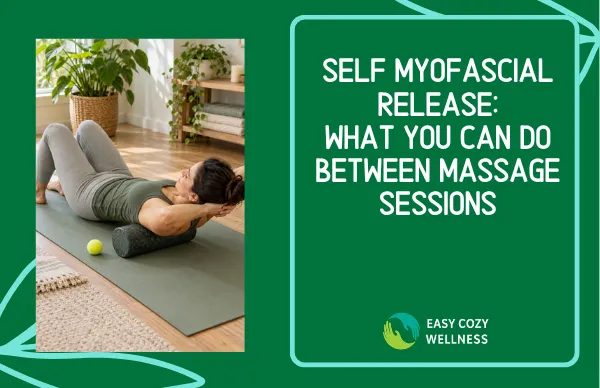
Self Myofascial Release: What You Can Do Between Massage Sessions
What Is Self Myofascial Release, Anyway?
Fascia is the connective tissue that wraps around your muscles, holding everything in place like a web. When it's healthy, it glides smoothly. When it's tight or stuck from stress, poor posture, repetitive movement, or just sitting too long, it can pull on the muscle underneath and make that whole area feel stiff, achy, or restricted. Myofascial release is the general term for techniques that work on that tissue to help it loosen up. Self myofascial release simply means doing a gentle version of that work yourself, using your own body weight and some simple tools, in between your professional massage appointments.
It's not a replacement for hands-on bodywork. Think of it as maintenance you can do at home to help the results of your last massage last a little longer, and to keep everyday tightness from building up into something more stubborn.
Tools You Probably Already Have (or Can Get Cheaply)
You don't need anything fancy to get started. A few widely available, low-cost tools cover most of what self myofascial release involves:
Foam roller — good for larger muscle groups like the back, glutes, and calves. A medium-density roller is usually more comfortable to start with than a firm one.
Tennis or lacrosse ball — better for smaller, more specific spots, especially against a wall or the floor where you need more control than a roller allows.
Your own body weight — that's really the mechanism. You're using gravity and slow, controlled movement to apply gentle, sustained pressure to a tight area.
None of this requires special training. It just requires patience and a light touch, which is often the opposite of what people assume.
Where to Focus (and a Few Areas to Leave Alone)
Some areas respond well to self myofascial release and are relatively easy to work on your own:
Upper back — lie on a foam roller placed horizontally under your shoulder blades and rock slowly, or use a ball against a wall for one side at a time.
Glutes — sit on a ball on the floor and shift your weight gradually to find a tender spot, then ease off before it becomes sharp.
Calves — roll from ankle to just below the knee, working slowly rather than fast.
A few areas are best left to a professional, or avoided entirely with self-tools: never roll directly on your spine, the front or side of your neck, or directly over a joint like the knee or elbow. These areas have less muscle padding and more sensitive structures underneath, and pressure there is more likely to cause irritation than relief.
How to Do It: Slow and Controlled Beats Aggressive
The biggest mistake people make with self myofascial release is treating it like a workout — rolling fast, pressing as hard as possible, and trying to "power through" discomfort. That approach usually backfires. Instead:
Move slowly. A few inches every few seconds is plenty.
When you find a tender spot, pause there and breathe rather than grinding into it.
Aim for pressure that feels like a firm, tolerable stretch — not pain.
Keep sessions short. Two to five minutes per area is usually enough.
Give it time. Fascia responds to consistency over days and weeks, not a single aggressive session.
Safety Notes Worth Repeating
This is general self-care information, not a treatment plan, and it's worth being honest about its limits. Stop immediately if you feel sharp pain, numbness, tingling, or if a spot feels worse rather than better after working on it. Avoid rolling directly on the spine, joints, varicose veins, or any area that's bruised, swollen, or recently injured. If you have a diagnosed condition, a recent injury, or you're not sure whether an area is safe to work on, check with a healthcare provider before trying self myofascial release there. And if something doesn't feel right, don't push through it hoping it will resolve on its own — that's exactly the kind of thing worth bringing up with a practitioner instead.
Why a Professional Deep Tissue Session Still Matters
Self myofascial release is a genuinely useful tool between appointments, but it has real limits. A foam roller can't reach the way skilled hands can, especially around the shoulder blades, along the spine, or deep into glute and hip tissue where a lot of chronic tightness likes to sit. A trained practitioner can also feel the difference between tissue that's simply tight and tissue that needs a different approach entirely, and adjust pressure and technique in ways a tennis ball against a wall never will. That precision is especially useful for longstanding tightness or discomfort, which is part of why we built a dedicated page on back pain massage in Nanaimo for people dealing with that specific issue.
At Easy Cozy Wellness, full body massage sessions default to deep tissue pressure, with lighter pressure available on request. Our practitioners hold NHPC credentials. Current pricing:
30 minutes — $38 CAD
60 minutes — $70 CAD
90 minutes — $105 CAD
120 minutes — $135 CAD
Booking is simple, same-day appointments are generally available, and there's a 4-hour cancellation policy. You can book directly through our booking page.
FAQ
Is self myofascial release the same as a deep tissue massage?
No. It's a simplified, self-administered version of a similar idea — working on the fascia around your muscles. A professional session involves trained hands that can adjust pressure, angle, and technique in real time, which a foam roller or ball can't replicate.
How often can I do this at home?
Many people find a few short sessions a week, a few minutes per area, works well. There's no need to do it daily, and more isn't automatically better — consistency matters more than frequency.
Should this hurt?
You should feel pressure and possibly some tenderness on tight spots, similar to a firm stretch. Sharp, shooting, or worsening pain is a sign to stop, not push through.
Can self myofascial release replace regular massage therapy?
It's a helpful complement, not a substitute. It can help maintain the loosening effect between sessions, but it doesn't reach tissue the way a trained practitioner can, and it isn't a substitute for professional assessment if something feels persistently wrong.
What if I don't have a foam roller or ball?
You can start with just a tennis ball, which is inexpensive and widely available, and add a foam roller later if you find the practice useful.
Easy Cozy Wellness is a massage therapy studio in Nanaimo, BC, offering registered NHPC practitioners, straightforward online booking, and same-day appointments when available. We believe the best results come from combining skilled hands-on care with simple habits you can maintain on your own between visits.

