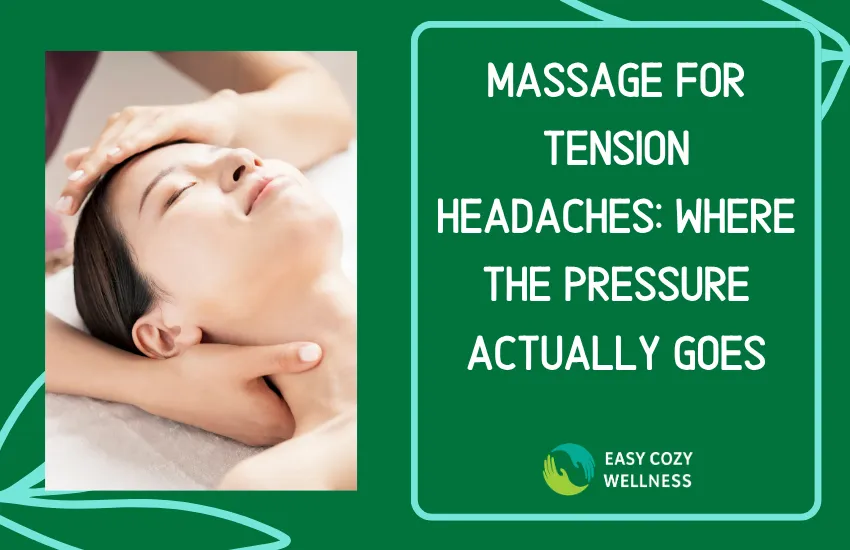
Massage for Tension Headaches: Where the Pressure Actually Goes
Massage for Tension Headaches: Where the Pressure Actually Goes
Most people who have tried massage for tension headaches report one of two experiences. Either the session helped significantly and they want to understand why, or the session did not help and they want to know what went wrong.
The answer in both cases comes down to whether the massage reached the right anatomical structures. Tension headaches are not a head problem. They are a muscle problem, and the muscles causing them are almost always located in the neck, scalp, and jaw, not in the skull itself. Massage that reaches these structures produces lasting relief. Massage that does not reach them produces temporary relaxation at best.
This post explains exactly where therapeutic pressure needs to go during a headache massage session, and why this differs from what most clients receive in a standard treatment.
What Is a Tension Headache and Where Does It Come From?
According to the World Health Organization, tension-type headache is the most common headache disorder globally, affecting up to 78 percent of the general population at some point in their lives. Despite the prevalence, the mechanism is frequently misunderstood.
A tension headache is produced by sustained isometric contraction in specific muscle groups: primarily the suboccipital muscles at the base of the skull, the splenius capitis and semispinalis capitis along the back of the neck, the temporalis across the temples, and the upper trapezius between the neck and shoulder. When these muscles remain contracted for extended periods, they accumulate metabolic byproducts including prostaglandins and bradykinin, which sensitise local pain receptors and produce the characteristic band-like pressure around the head.
Over-the-counter analgesics address the prostaglandin pathway chemically. Massage addresses the contraction itself mechanically. The evidence for manual therapy in tension headache management is substantial: a 2017 Cochrane review found that massage and manual therapy produced clinically meaningful reductions in headache frequency, intensity, and duration, with effects comparable to prophylactic pharmacological treatments and without the associated side effects.
The Four Muscle Groups That Drive Most Tension Headaches
1. The Suboccipital Group
The four suboccipital muscles sit between the base of the skull and the first two cervical vertebrae. They are among the most densely innervated muscles in the human body and are exceptionally sensitive to postural stress. When a person holds their head forward of their centre of gravity, as nearly all screen users do, the suboccipitals sustain a continuous eccentric load that converts into the characteristic headache that starts at the base of the skull and radiates over the top of the head.
Effective massage for tension headaches must reach this group. The suboccipitals are located underneath the larger superficial neck muscles and require specific, bilateral, sustained pressure at the occipital ridge to release.
2. The Temporalis
The temporalis muscle fans across the temple from the zygomatic arch to the parietal bone. It is the primary jaw-closing muscle and becomes chronically overloaded in people who clench their teeth during sleep or sustain facial tension during concentration and stress. Temporalis trigger points refer pain into the temple and forehead, producing the frontal and temporal components of a tension headache.
Many headache massage treatments miss the temporalis entirely because it is not intuitively associated with headache. At Easy Cozy Wellness, temporalis work is incorporated into every head and neck massage session as standard.
3. The Upper Trapezius
The upper trapezius runs from the cervical vertebrae and occiput to the shoulder girdle. It is one of the most commonly overloaded muscles in adults with desk-based occupations and is directly implicated in tension headache generation through its referral pattern: active trigger points in the upper trapezius refer pain up into the back of the head and temple area, mimicking and contributing to tension headache patterns.
According to Physiopedia, the upper trapezius is listed as a primary headache-contributing structure in adults with prolonged postural loading. Treating the head without addressing the upper trapezius leaves a significant driver of the headache pattern unresolved.
4. The Splenius Capitis and Cervical Muscles
The splenius capitis and the deeper cervical muscles including the semispinalis capitis and longissimus capitis connect the cervical spine to the base of the skull. These muscles sustain the weight of the head during prolonged forward flexion and develop chronic shortening patterns that directly contribute to cervicogenic headache referral into the back and sides of the head.
What a Properly Targeted Massage for Tension Headaches Looks Like
A therapeutic headache massage session at Easy Cozy Wellness follows this sequence:
Intake to identify the headache pattern: location, timing, triggers, and whether jaw tension or neck stiffness is present
Upper trapezius and cervical muscle preparation with broad strokes to increase circulation and warm the tissue
Suboccipital bilateral pressure at the occipital ridge, held for 60 to 90 seconds per side until the muscle releases
Splenius capitis and semispinalis work along the posterior cervical chain
Temporalis release along the full length of the muscle from the zygomatic arch to the parietal bone
Scalp and galea work to address circulation and connective tissue restriction across the top of the skull
Integration strokes to close the session and allow the nervous system to settle
Sessions addressing tension headaches start at $38 for 30 minutes and are available without a referral at Easy Cozy Wellness in North Nanaimo, Tuesday to Saturday, 10 AM to 8 PM.
Further Reading
For clients whose headaches have a strong cervicogenic component driven by neck tension, our headaches and migraines massage page in Nanaimo covers the full range of headache presentations we treat at Easy Cozy Wellness. If jaw clenching or temporalis tightness is a significant driver of your headache pattern, our head massage in Nanaimo guide explains how jaw and temple tension are addressed in a single session. And if your headaches are consistently one-sided, headache on the right side of the head: what it means and how massage helps covers the lateralised cause and treatment approach.
Final Suggestion
If you have been managing tension headaches with over-the-counter medication, stretching, or general relaxation massage without lasting resolution, the limiting factor is almost certainly that the treatment has not reached the specific muscle groups driving your headache pattern.
At Easy Cozy Wellness in Nanaimo, we treat tension headaches by working directly into the suboccipital group, temporalis, upper trapezius, and cervical muscles that produce the contraction pattern behind most tension-type headaches. Rather than masking the symptom, we address the mechanical source. If you want to understand exactly which muscle is causing your specific headache location, headache on the right side of the head: what it means and how massage helps breaks down the three most common lateralised drivers in detail. And if you are unsure whether your headaches are tension-type or cervicogenic, tension headache massage: a practical guide for Nanaimo sufferers explains the distinction and what a properly structured treatment session looks like for each.
Sessions start at $38 for 30 minutes. No referral required. Same-day appointments are frequently available.
Take a look at our testimonials and see what Nanaimo clients say about their headache relief results.
Book your session today and experience the difference for yourself.

