Back Pain for Office Workers in Nanaimo: A Real Guide
Back Pain for Office Workers in Nanaimo: A Real Guide
Back pain for office workers in Nanaimo follows a pattern so consistent that we can predict which muscles are involved before a client even sits down: tight hip flexors, inactive glutes, overloaded lumbar erectors, and at least one well-established trigger point in the QL. This post explains why desk work creates this specific pattern, what actually resolves it, and how to get treatment in Nanaimo this week without a referral or a waitlist.
Back Pain for Office Workers in Nanaimo: A Real Guide
Why desk work causes back pain in this specific pattern
Mechanism 1: Lumbar disc compression
Mechanism 2: Hip flexor shortening
Mechanism 4: Static loading and trigger point development
The office worker back pain cycle
What actually works (and what does not)
Your desk setup is either hurting or helping
How to fix back pain from desk work in Nanaimo
Why do office workers in Nanaimo get back pain?
How do I treat back pain from my desk job in Nanaimo?
How many massage sessions do I need for office-related back pain?
Why desk work causes back pain in this specific pattern
Desk work creates back pain through four overlapping mechanisms that reinforce each other over weeks and months. According to Statistics Canada, back pain is the leading cause of work-related disability among Canadian office workers, with prolonged sitting and poor ergonomics identified as the primary modifiable risk factors, and the prevalence is increasing as remote and hybrid work extends screen time beyond traditional office hours (Statistics Canada, 2024: https://www.statcan.gc.ca/en/start).
Mechanism 1: Lumbar disc compression
Sitting compresses the lumbar discs unevenly, particularly when the natural lumbar curve is flattened by a forward-leaning or rounded sitting posture. Hours of uneven disc compression reduces disc health over time and creates the deep, aching quality that distinguishes disc-adjacent back pain from pure muscle pain.
Mechanism 2: Hip flexor shortening
The hip flexors, the muscles connecting the lower spine to the upper femur, remain in a shortened position throughout the working day when sitting. Chronically short hip flexors pull the pelvis forward into anterior tilt, which increases lumbar compression and maintains a constant strain on the lower back muscles. This is the primary driver of the end-of-day lower back ache that most office workers experience.
Mechanism 3: Glute shutdown
Sitting switches off the glute muscles, the primary support structure for the lumbar spine. When glutes are inactive for eight or more hours a day, the lumbar erectors and QL must compensate by carrying load they were not designed to carry alone. This sustained compensatory overload is one of the primary drivers of office worker back pain that worsens progressively over months.
Mechanism 4: Static loading and trigger point development
Static muscle contraction, holding the same position without movement, reduces blood flow through the active muscles and creates the metabolic conditions that drive trigger point development. The lumbar erectors, QL and piriformis are the most common trigger point locations in desk-worker back pain. Established trigger points generate persistent pain and restrict movement, creating a cycle that worsens without intervention.
The office worker back pain cycle
For most desk job back pain, the experience follows a predictable weekly cycle: manageable discomfort on Monday morning, escalating pain through Wednesday, significant stiffness and aching by Friday, partial relief over the weekend, and return of symptoms within a few hours of sitting at the desk on Monday. Each week, the starting point is slightly worse than the week before.
This cycle indicates that the underlying muscle imbalances and trigger points are not resolving over the weekend. Rest reduces inflammation temporarily, but the established trigger points and shortened hip flexors remain intact. The following week of desk work loads the same structures from the same starting position, or a slightly worse one.
What actually works (and what does not)
What works
Targeted massage addressing the specific muscles involved: hip flexors, lumbar erectors, QL and piriformis. This deactivates the trigger points driving the pain and releases the hip flexor shortening maintaining the pelvic tilt.
Glute activation exercises: 10 slow glute bridges twice daily reactivate the muscles that sitting switches off. This is the most important daily exercise for desk-worker back pain.
Hip flexor stretching: low lunge position, 45 seconds each side, twice daily. Addresses the anterior pelvic tilt directly.
Movement breaks: 2-3 minutes of standing and walking every 45 minutes interrupts the static loading cycle and prevents trigger point accumulation.
Ergonomic correction: screen at eye level, lumbar support in the chair, keyboard close, feet flat. The single most impactful long-term change.
What does not work
Rest alone: the trigger points and hip flexor shortening remain through the weekend and reset the following week.
General lower back stretching without addressing hip flexors and glutes: addresses symptoms without the primary drivers.
A standing desk without also moving: standing in the same position creates its own static loading pattern.
Pain medication as a long-term solution: masks the symptom without addressing any of the five mechanisms.
Your desk setup is either hurting or helping
The most impactful desk changes for back pain from sitting all day in Nanaimo are:
Screen height: top third of the monitor at eye level. A screen that requires looking down maintains forward head position and cervical load that feeds into the thoracic and lumbar chain.
Chair height: feet flat on the floor, knees at 90 degrees or slightly below hip level. Knees above hips increases hip flexor load.
Lumbar support: a small rolled towel at the small of the back maintains the natural lumbar curve that sitting tends to flatten.
Mouse and keyboard position: elbows at 90 degrees, arms close to the body. Reaching forward to a mouse or keyboard elevates and protracts the shoulders, adding load to the thoracic chain.
According to the NHS, ergonomic adjustments combined with active treatment and movement breaks produce significantly better outcomes for work-related back pain than either intervention alone (NHS, 2024: https://www.nhs.uk/conditions/back-pain/).
How to fix back pain from desk work in Nanaimo
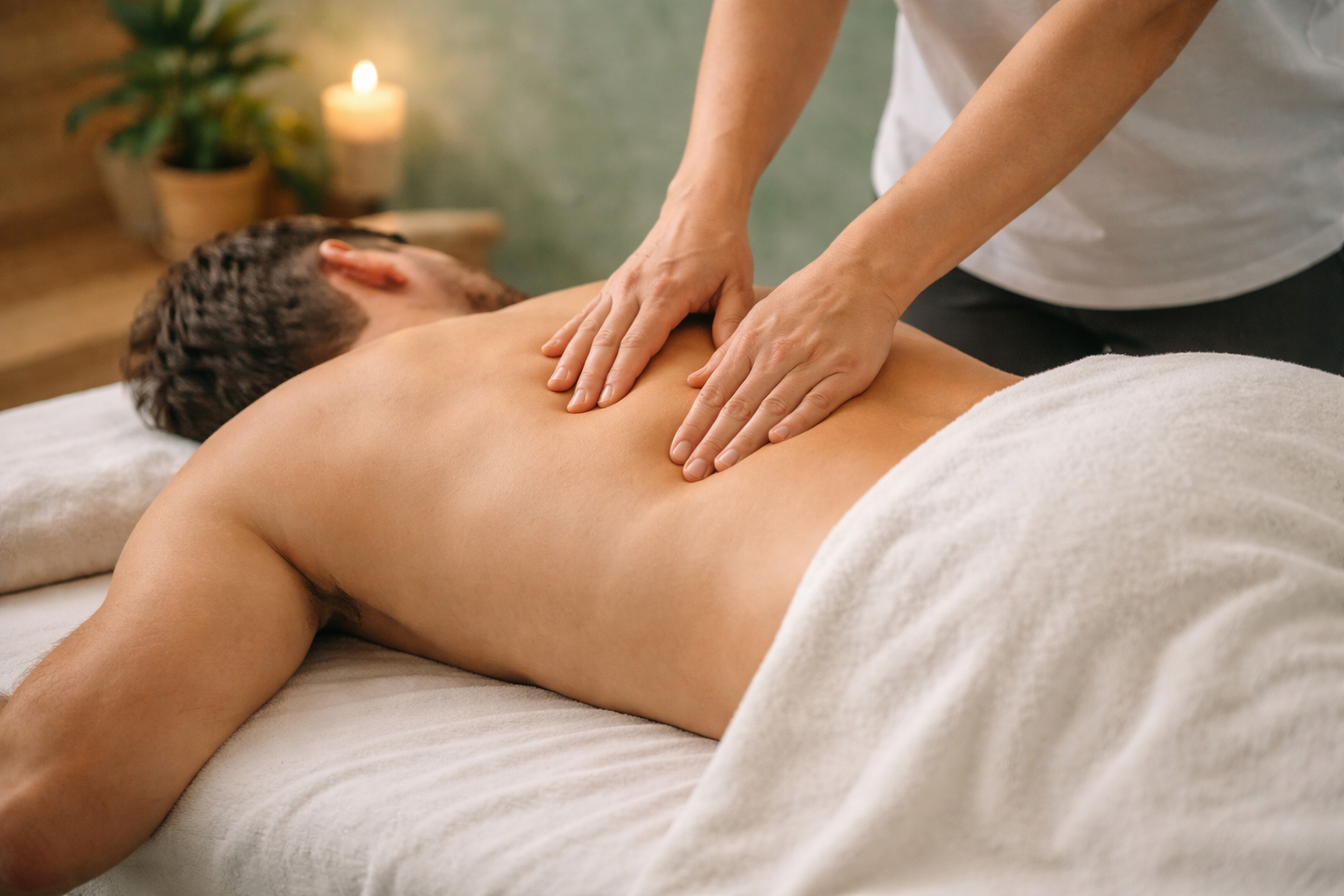
At Easy Cozy in Nanaimo, massage for office workers is our single most common treatment category. Sessions begin with an assessment identifying which of the four mechanisms is most active, which trigger points are present, how restricted the hip flexors are, whether the glute inhibition pattern is contributing, and treatment is directed specifically at those structures.
Acupressure is particularly effective for the QL and piriformis trigger points that standard massage does not always fully reach. Many clients with months of persistent desk-related back pain find that targeted acupressure on these structures produces a notably different and more complete release than the general back massage they may have received previously.
According to Health Canada's evidence position, massage therapy for work-related musculoskeletal pain is a safe, evidence-supported intervention that can be used as a primary or complementary treatment (Government of Canada, 2024: https://www.canada.ca/en/health-canada.html). No referral. No waitlist. Most sessions available within the same week, which means you can book now and be seen before your back pain escalates further.
For faster, longer-lasting results than self-treatment alone, come in for a session. We will address the root cause, not just the symptom. Book online in 2 minutes.
Book Now: https://easycozy.ca/booking
Frequently asked questions
Why do office workers in Nanaimo get back pain?
Office worker back pain in Nanaimo, as everywhere, comes from four overlapping mechanisms: lumbar disc compression from sustained sitting, hip flexor shortening from maintained sitting position, glute muscle shutdown removing the spine's primary support structure, and static loading creating trigger points in the lumbar muscles. Most office workers have all four operating simultaneously by the time they seek treatment.
How do I treat back pain from my desk job in Nanaimo?
The fastest approach combines professional massage targeting the specific muscles involved with daily glute activation exercises and hip flexor stretching at home, movement breaks every 45 minutes, and ergonomic corrections to your desk setup. Professional massage addresses the established trigger points and hip flexor shortening that self-management alone cannot fully resolve. Most clients notice significant improvement within one to two sessions.
How many massage sessions do I need for office-related back pain?
For back pain that has been building over several weeks, two to three sessions targeting the specific muscles involved typically produces significant sustained relief. For back pain that has been chronic for months, a short course of four to six sessions combined with the self-management steps above produces the most complete and lasting result. Monthly maintenance sessions prevent re-accumulation for people who continue in a desk-based role.
Can standing desks fix office worker back pain?
Standing desks reduce the sitting-related hip flexor shortening and disc compression, but create their own static loading pattern if used without movement. An alternating sit-stand approach, with regular position changes and movement breaks, is more effective than either standing or sitting all day. A standing desk does not address established trigger points or hip flexor shortening that has already developed. Professional massage treatment is needed alongside the ergonomic change for complete resolution.
Final Suggestion
If you’re looking for massage therapy in Nanaimo that helps you feel relaxed, refreshed, and back to your best, Easy Cozy Wellness is here to help.
We focus on real results, not just temporary relief. Whether you’re dealing with daily tension, chronic discomfort, or simply need time to unwind, our treatments are designed to support your body and your overall well-being.
We regularly help clients with:
• Back pain
• Neck pain
• Shoulder pain
• Lower back pain
• Lumbar pain
• Headaches and migraines
• Sciatic pain (sciatica)
• Hip pain
• Knee pain
• Elbow pain (tennis elbow, golfer’s elbow)
• Leg pain and muscle tightness
• Foot pain and plantar fasciitis
• Hand and wrist pain (including carpal tunnel symptoms)
• Joint pain and inflammation
• Muscle soreness and post-workout recovery
• Chronic pain conditions
• Nerve pain and tension
• Upper back and mid-back pain
• Glute pain and piriformis syndrome
• Calf tightness and strain
• Shin splints
• Ankle pain and mobility issues
• Postural pain from sitting or desk work
• Repetitive strain injuries (RSI)
• Stress, tension, and fatigue
Our services include:
• Relaxation massage
• Deep tissue massage
• Therapeutic massage
• Pain relief massage
• Stress relief treatments
• Wellness and recovery sessions
• Preventative body care
At Easy Cozy Wellness, the goal is simple. Help your body feel better, move better, and recover faster.
If you’ve been searching for:
massage therapy Nanaimo
best massage Nanaimo
affordable massage Nanaimo
deep tissue massage Nanaimo
relaxation massage Nanaimo
pain relief massage Nanaimo
wellness clinic Nanaimo
You’re in the right place.
Give us a call at 778-561-0208 and book your next wellness appointment today.
Or visithttps://easycozy.ca/tolearn more about our services, see current offers, and review our satisfaction guarantee.
We’re proud to offer a more affordable option compared to many local providers, without compromising on quality or results.
Once you experience the difference, you’ll understand why so many people choose Easy Cozy Wellness for ongoing care.
You can schedule your massage appointment here:
Relaxation is not a luxury — it’s an essential part of staying healthy and energized.
Your body will thank you. Talk soon.

